

Schedule Appointment


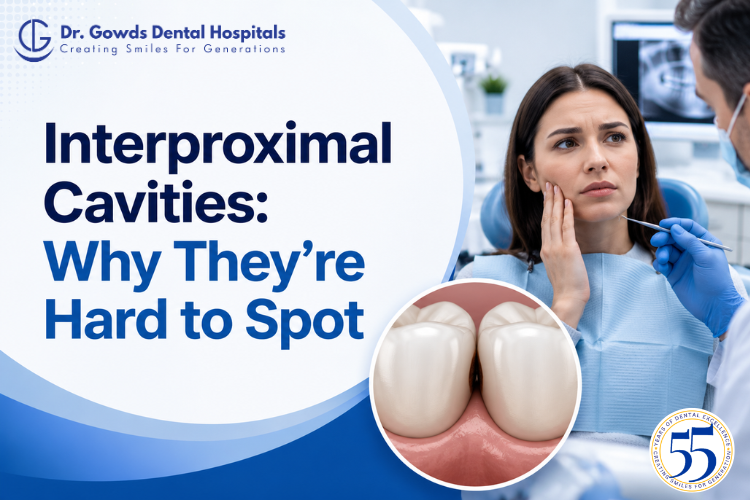
Interproximal Cavities are areas of tooth decay that develop between two adjacent teeth. Unlike cavities on the chewing surface or front of a tooth, they are often hidden from view, making them difficult to detect during the early stages. Because these cavities form in areas that are hard to clean and difficult to examine without dental X-rays, they may progress significantly before causing noticeable symptoms. Early diagnosis through regular dental check-ups and proper interdental cleaning can help prevent extensive tooth damage.
At Dr. Gowds Dental Hospitals, advanced digital imaging and comprehensive dental examinations help detect interproximal cavities at an early stage, allowing for more conservative treatment whenever possible.
Interproximal Cavities are cavities that develop on the surfaces where two neighboring teeth touch each other.
These contact areas are called interproximal surfaces.
Unlike visible cavities on the front or top of a tooth, interproximal cavities remain hidden between teeth, making them one of the most commonly missed forms of tooth decay.
Without early detection, they may spread deeper into the tooth before they become noticeable.
The biggest challenge with Interproximal Cavities is their location.
The space between adjacent teeth is:
Even with careful brushing, these narrow spaces often retain plaque and food particles.
In many cases, the cavity cannot be seen until it has progressed significantly.
For this reason, dentists frequently rely on bitewing dental X-rays to identify hidden decay.
Like all cavities, interproximal cavities begin with plaque accumulation.
The process usually follows these stages:
Bacteria combine with food debris and saliva to form dental plaque between the teeth.
Step 2: Acid Production
After consuming sugary or starchy foods, plaque bacteria produce acids.
These acids gradually dissolve minerals from the enamel.
Step 3: Enamel Demineralization
Repeated acid attacks weaken the enamel between the teeth.
At this stage, the damage may still be reversible with appropriate preventive care.
Step 4: Cavity Formation
As mineral loss continues, a permanent cavity develops.
Without treatment, the decay progresses deeper into the tooth.
Interproximal areas provide an ideal environment for bacteria because they:
Since these cavities are hidden, patients may not seek treatment until the decay reaches deeper layers of the tooth.
Several factors increase the risk.
Common causes include:
A combination of these factors often contributes to cavity development.
Early Interproximal Cavities often produce no symptoms.
As decay progresses, you may notice:
Some patients experience no discomfort until the cavity reaches the inner dentin or pulp.
Usually, no.
Because the decay develops between teeth, it is often invisible in a mirror.
Even dentists may not detect very early lesions through visual examination alone.
This is why routine dental X-rays play an important role in early diagnosis.
It depends on the stage.
If decay has not formed a true cavity, fluoride therapy and improved oral hygiene may help remineralize the enamel.
Once a cavity has formed, it cannot repair itself naturally.
Professional treatment is required to restore the damaged tooth.
Treatment depends on the extent of decay.
Small cavities are commonly treated with tooth-colored composite fillings.
These restore both appearance and function.
Larger cavities that do not require a full crown may be restored with custom-made inlays or onlays.
If extensive tooth structure has been lost, a dental crown may provide long-term protection.
If decay reaches the dental pulp and causes irreversible infection, Root Canal Treatment may be necessary before restoring the tooth.
Ignoring cavities between teeth can lead to:
Early treatment is generally simpler and helps preserve more natural tooth structure.
Interproximal Cavities are among the most difficult forms of tooth decay to detect because they develop in hidden spaces between adjacent teeth. These areas are challenging to clean thoroughly and often show few or no symptoms until the decay has progressed. Regular flossing, routine dental examinations, and timely bitewing X-rays play a crucial role in identifying these cavities before they require more extensive treatment.
If you experience tooth sensitivity, food trapping, or discomfort between your teeth, consult the experienced dental team at Dr. Gowds Dental Hospitals. Early diagnosis and appropriate treatment can protect your natural teeth and help maintain long-term oral health.
Visit us at-
Dr gowds dental hospital Nanakramguda
Dr gowds dental hospital Gachibowli
Dr gowds dental hospital madhapur
Interproximal Cavities are areas of tooth decay that develop between two adjacent teeth, where they are often hidden from view.
They form in areas that cannot be easily seen during routine brushing or visual examination. Bitewing dental X-rays are often needed to detect them early.
No. Brushing cleans the visible tooth surfaces, but flossing or other interdental cleaning methods are needed to remove plaque between teeth.
Very early enamel demineralization may improve with fluoride and good oral hygiene. Once a cavity forms, professional dental treatment is required.
The need for dental X-rays depends on your individual cavity risk and oral health. Your dentist will recommend an appropriate schedule based on clinical findings and preventive care needs.
 Gachibowli Branch