

Schedule Appointment

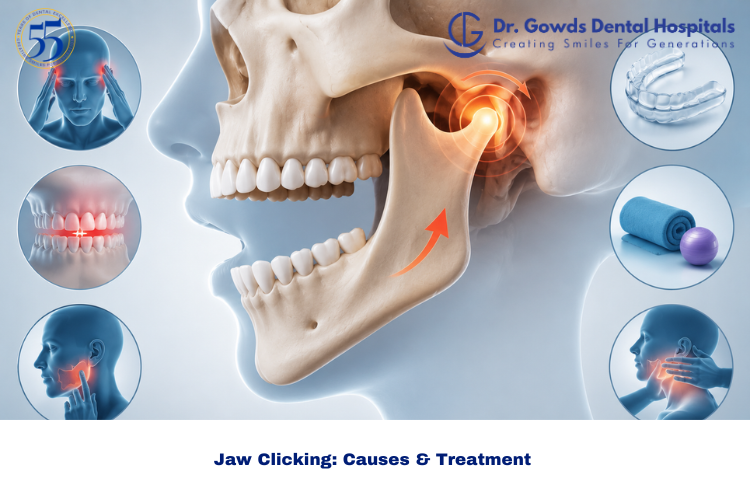
Jaw clicking while chewing usually occurs when the temporomandibular joint (TMJ) does not move smoothly. Common causes include TMJ disorders, displacement of the joint disc, teeth grinding, bite misalignment, arthritis, or muscle tension. While occasional jaw clicking may not be serious, persistent clicking accompanied by pain, jaw locking, headaches, or difficulty chewing should be evaluated by a dental professional.
At Dr. Gowds Dental Hospitals, jaw clicking is one of the most common TMJ-related concerns evaluated by specialists. Early diagnosis can help prevent worsening joint problems and improve overall oral function.
Jaw clicking refers to a popping, snapping, or clicking sound that occurs when you:
The sound usually originates from the temporomandibular joint (TMJ), which connects the lower jaw to the skull.
Some people experience jaw clicking occasionally without discomfort, while others develop pain, restricted movement, and chronic TMJ disorders.
Understanding the underlying cause is essential for determining whether treatment is needed.
The temporomandibular joint is one of the most complex joints in the body.
It allows the jaw to:
Inside the joint is a small cartilage disc that acts as a cushion between the jawbone and skull.
When this disc moves out of position or the joint becomes strained, jaw clicking can occur.
Several factors can cause jaw clicking while eating.
One of the most common causes of jaw clicking is disc displacement.
Normally, the cartilage disc sits between the jawbone and skull and moves smoothly during jaw function.
When the disc shifts out of position, it may temporarily snap back into place as the mouth opens or closes.
This creates the characteristic clicking sound.
Disc displacement is often the earliest stage of TMJ dysfunction.
Jaw clicking is frequently associated with TMJ disorders.
TMD affects the:
Not every person with jaw clicking has TMD, but persistent symptoms often indicate joint dysfunction.
Many people grind or clench their teeth without realizing it.
This condition, known as bruxism, places excessive pressure on the jaw joints.
Over time, the increased stress may contribute to:
Stress is one of the leading triggers for nighttime grinding.
The way your upper and lower teeth fit together influences how your jaw moves.
Conditions such as:
can place uneven stress on the TMJ.
When the jaw compensates for an improper bite, clicking sounds may develop.
Like other joints in the body, the TMJ can be affected by arthritis.
Arthritis may cause:
Older adults are generally more susceptible, although arthritis can occur at any age.
Previous trauma can alter the way the TMJ functions.
Examples include:
Even injuries that occurred years earlier can contribute to ongoing jaw clicking.
Stress often leads to unconscious jaw clenching.
This places additional strain on the muscles surrounding the TMJ.
As tension increases, jaw movement may become less coordinated, resulting in clicking sounds and discomfort.
Occasional jaw clicking without pain is relatively common.
In many cases, it may not require immediate treatment.
However, jaw clicking should not be ignored if it occurs alongside:
Persistent symptoms often indicate an underlying TMJ problem that requires professional assessment.
Pain near the ears or jaw joints is one of the most common associated symptoms.
Jaw dysfunction may make eating uncomfortable or difficult.
TMJ disorders frequently cause recurring headaches and facial tension.
Some patients experience:
Because of the close proximity between the TMJ and ear structures.
A displaced disc may occasionally prevent normal jaw movement.
Some individuals experience temporary locking when opening or closing the mouth.
Overworked jaw muscles may feel sore, tired, or tender throughout the day.
While not all causes are preventable, healthy habits can reduce your risk.
Prevention Tips
Preventive care often helps avoid long-term TMJ complications.
Jaw clicking while chewing is often linked to temporomandibular joint dysfunction, disc displacement, teeth grinding, bite problems, or muscle tension.
Although occasional clicking without pain may not be a cause for concern, persistent jaw clicking should never be ignored—especially when accompanied by pain, headaches, jaw locking, or difficulty chewing.
Early diagnosis can help prevent complications and improve overall jaw function.
If you are experiencing persistent jaw clicking, a professional evaluation at Dr. Gowds Dental Hospitals can help identify the cause and determine the most effective treatment for lasting relief.
Visit us at-
Dr gowds dental hospital Nanakramguda
Dr gowds dental hospital Gachibowli
Dr gowds dental hospital madhapur
No. While TMJ disorders are a common cause, jaw clicking can also result from disc displacement, teeth grinding, arthritis, bite problems, or previous jaw injuries.
Painless jaw clicking often occurs when the joint disc moves slightly out of position. Although it may not require immediate treatment, persistent clicking should still be monitored.
Yes. Stress can lead to teeth clenching and muscle tension, which place additional strain on the TMJ and contribute to jaw clicking.
You should seek professional evaluation if jaw clicking is accompanied by pain, headaches, jaw locking, difficulty chewing, swelling, or changes in your bite.
Some cases resolve naturally, especially if caused by temporary muscle tension. However, ongoing or worsening symptoms should be evaluated by a dental professional.
 Gachibowli Branch