

Schedule Appointment


If one side of my face looks bigger than the other in the mirror or in photos, you’re not imagining it — and you’re not alone in asking. Most people who notice this imbalance are surprised to learn there are actually three different mechanisms behind it — and they look nearly identical in the mirror but require completely different responses. The first is structural: bone or jaw differences present since childhood or adolescence. The second is muscular: the masseter muscle on one side has grown larger due to chewing habits, teeth grinding, or bite imbalance. The third is soft tissue: temporary puffiness from fluid retention, sinus congestion, or a dental issue. Knowing which category you’re dealing with determines whether the answer is a lifestyle change, a dental assessment, or an urgent medical check.
Written by: Prof. Dr. Snigdha Gowd, MDS (Orthodontics & Dentofacial Orthopaedics)
Noticed one side of your face looking fuller or uneven? Dr Gowds Dental Hospitals 5D facial scan identifies whether it’s muscle, structure, or dental — before recommending anything
Quick Answer: One side of your face can look bigger due to muscle (masseter enlargement from one-sided chewing), fluid (sleep position or sinus swelling), bite misalignment, or natural bone structure. Fluid causes reduce within hours; muscle and bite causes stay constant and need a dental assessment to correct.
Before going through the causes, it is worth addressing the first thing most people notice: the asymmetry seems far more obvious in photographs — especially selfies — than it does when you look in a mirror. This is not your imagination, and it does not necessarily mean your face has changed.
When you look in a mirror, you see a horizontally flipped version of your face. You have seen this version your entire life, so your brain perceives it as “you” and normalises any asymmetry in it. A photograph captures your face as everyone else actually sees it — the non-flipped version — and that subtle difference registers as unfamiliar and therefore more noticeable.
On top of that, phone front cameras use wide-angle lenses that distort proportions at close range, and a face photographed from even slightly below eye level will make one jawline or cheek appear more prominent than the other. Lighting that comes more strongly from one side casts the opposite side in shadow, amplifying any difference further.
Quick self-check: Take a photograph at eye level, at least 60 cm from your face, in even natural light (not indoor overhead lighting, not a window directly to one side). This is the most accurate view. If the asymmetry is still clearly visible in this photo, it is real and worth investigating. If it mostly disappears, the photos you have been looking at were amplifying it through angle and light.
That said — photographs are also useful for spotting genuine asymmetry that you have learned to overlook in the mirror. Many people genuinely have one side larger than the other for real structural, muscular, or dental reasons, and photos are often what finally makes it undeniable. The point is not to dismiss what you see, but to ensure you are looking at an accurate picture before drawing conclusions.
Yes — mild asymmetry is natural. Every face has slight variations, and no two sides are identical. This natural difference is often subtle and not noticeable in daily life.
However, when the asymmetry becomes more obvious, persistent, or appears suddenly, many people begin to wonder why one side of my face looks bigger than the other. In such cases, it may indicate:
Although not always dangerous, noticeable asymmetry is usually treatable once the underlying cause is identified.
One side appearing bigger is the most commonly noticed form of facial asymmetry — and the causes range from temporary to structural.
Let’s explore the most common reasons people say “one side of my face looks bigger” and what each one means for your health.
If you chew predominantly on one side or clench your jaw on one side during stress or screen work, the masseter muscle can enlarge over time.
Signs:
This is one of the top causes of facial asymmetry in working professionals.
WHAT ACTUALLY HELPS
Consciously redistribute your chewing — aim for 60% on the non-dominant (smaller) side at every meal, starting with soft foods. Add jaw resistance exercises on the weaker side. If a dental issue (pain, missing tooth, broken restoration) is forcing you to one side, that needs treatment first — the habit cannot be corrected until the reason for it is removed. A dentist can confirm this with a clinical assessment.
Constant pressure on one side of the face can flatten or push the tissues slightly inward, making the opposite side appear bigger.
Signs:
This habit-related cause is easy to miss but common.
WHAT ACTUALLY HELPS
Alternate your sleep side intentionally — it takes 2 to 3 weeks to break a deeply ingrained sleep side preference, but it is achievable. Sleeping on your back eliminates the issue entirely and is the fastest fix. A memory foam pillow that cradles rather than compresses the face reduces tissue pressure if side sleeping is unavoidable. Two minutes of gentle lymphatic drainage massage on waking — upward strokes from jaw to temple — reduces morning fluid accumulation on the compressed side.
If your teeth don’t align properly, the jaw shifts to one side, causing the muscles and bones to compensate over time. Many patients report one side of my face looks bigger after years of untreated bite imbalance.
Signs:
Dental-related asymmetry is one of the most treatable causes.
A missing molar or uneven bite is often the hidden driver — see our guide on how teeth and bite cause facial asymmetry including the jaw effects.
WHAT ACTUALLY HELPS
Dental assessment and bite correction — this may mean orthodontic treatment to realign teeth, replacement of missing teeth (implants or bridges), or reshaping worn tooth surfaces. Once the bite is balanced, the muscle loading equalises and the facial difference often reduces over months. This is one of the most reliably treatable causes of facial asymmetry.
When the temporomandibular joint is inflamed or misaligned, one side of the face can swell, stiffen, or appear fuller.
Signs:
TMJ-related facial asymmetry can gradually worsen if untreated.
WHAT ACTUALLY HELPS
TMJ disorder needs professional assessment to determine the type and severity — treatments range from a custom night guard (splint) to physiotherapy, anti-inflammatory management, and in some cases injection therapy. Self-treating with jaw exercises without a diagnosis can worsen certain TMJ conditions. If you have the symptoms above, see a dental specialist before starting any jaw exercise programme.
Sometimes facial asymmetry is temporary and linked to inflammation.
Possible triggers:
This makes the cheek, eye area, or jaw appear swollen on one side.
Some individuals naturally develop one cheekbone, jaw angle, or orbital bone slightly differently than the other. This structural asymmetry usually becomes more noticeable with age or weight changes.
Signs:
This is normal but may still be improved cosmetically.
WHAT ACTUALLY HELPS
Exercises and dental treatment cannot change bone structure. For people bothered by structural asymmetry, options include contouring treatments (dermal filler on the smaller side to add volume), jaw reduction on the larger side, or orthognathic (jaw repositioning) surgery for significant cases. A facial assessment will clarify whether any of these are appropriate for your degree of difference and goals.
As we age, volume loss doesn’t occur equally on both sides. One side may lose fat faster, causing the other side to look fuller in comparison.
Signs:
This imbalance can be improved with targeted treatments.
If one side of your face suddenly looks puffy rather than just “bigger,” the cause is almost always fluid or inflammation — not muscle or bone. The two questions sound similar but point to different things: “bigger” is often long-standing and structural or muscular, while “puffy” usually means something changed recently and involves swelling.
The fastest way to tell them apart: puffiness is soft, and often reduces within an hour or two of waking up. A structural or muscular difference stays exactly the same all day.
The masseter is the large jaw-clenching muscle that runs from your cheekbone to your lower jaw. When it is overused on one side — through habitual one-sided chewing, nighttime teeth grinding (bruxism), or an uneven bite that forces one side to work harder — it gradually hypertrophies: it grows bigger, just like any overworked muscle. The result is a visibly wider, squarer, or more prominent jawline on one side. This is one of the most common reasons one side of the face looks larger, and it is directly tied to dental causes.
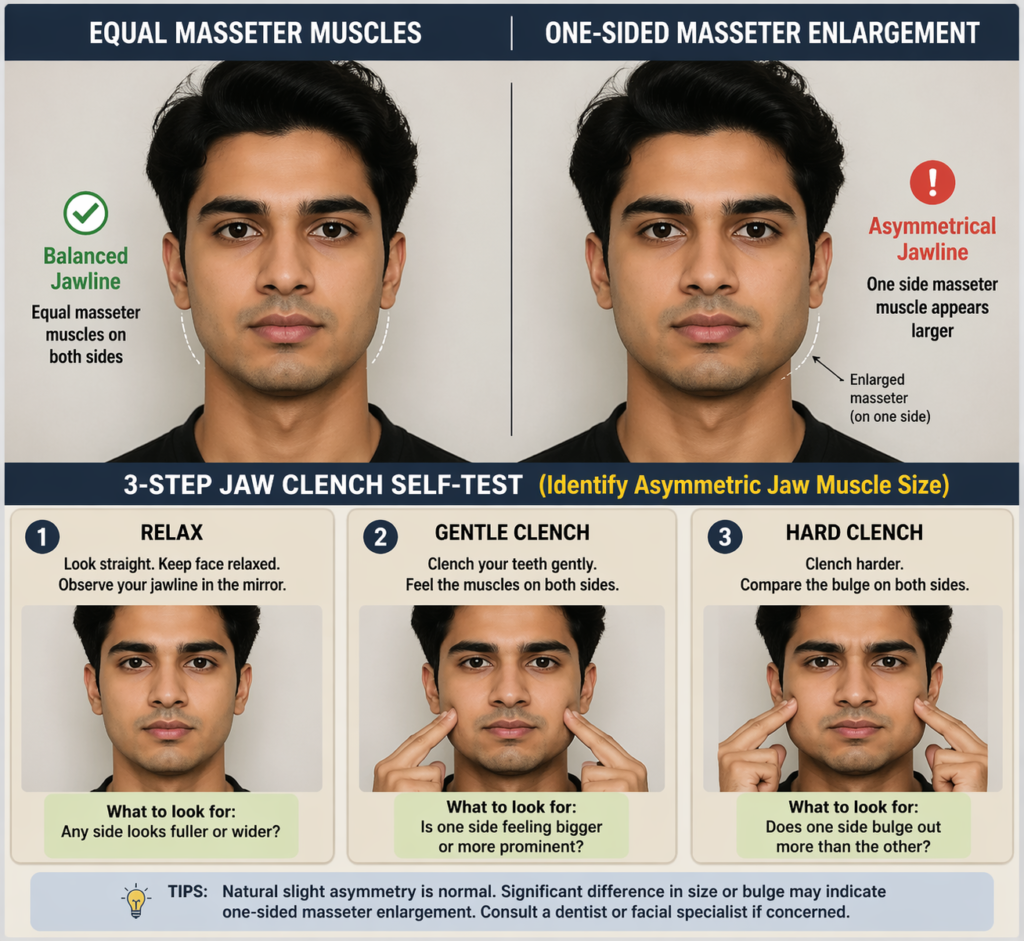
How to tell if it’s masseter hypertrophy: Place your fingers on the outer angle of your jaw (just below the ear). Clench your teeth firmly. If one side bulges noticeably more than the other when clenched, asymmetric masseter size is likely contributing to your facial imbalance.
What makes it worse: Consistently chewing on the same side, teeth grinding at night, missing molars (which forces the opposite side to compensate), TMJ dysfunction, and poorly fitted dental restorations.
The dental connection: When a molar is lost and not replaced, the jaw on that side loses structural support. The opposing muscles overcompensate, and the masseter on the working side enlarges progressively over months and years. This is why replacing missing teeth promptly is not just a cosmetic decision — it protects the structural balance of your entire lower face.
When the temporomandibular joint is dysfunctional, the jaw adapts by overworking one side — we explain how TMJ causes one side of the jaw to enlarge in detail.
This is one of the most specific searches people make on this topic, and it almost never gets a direct answer. Here is one: the side that looks bigger is almost always the dominant side — the side you use more.
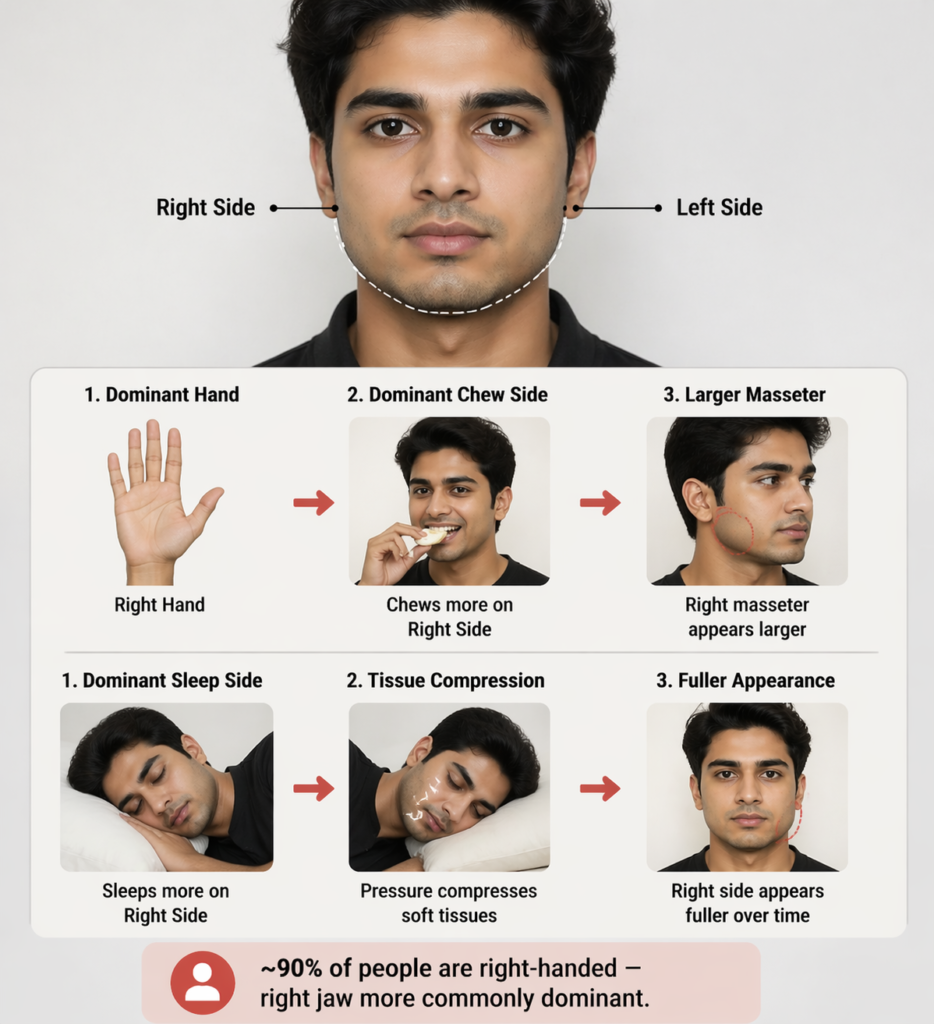
Because approximately 90% of people are right-handed, the right masseter muscle is more likely to be the dominant chewing muscle, making the right jaw and cheek slightly fuller or more prominent. This is not a rule — left-side dominance is equally valid — but it is why “my right side is bigger than my left” is statistically the more common complaint.
The same applies to sleeping position: if you consistently sleep on your right side, that side experiences more sustained soft tissue compression and fluid pooling, particularly visible first thing in the morning. Over time, chronic one-sided sleeping can create a lasting soft tissue asymmetry. The fix is the same regardless of which side: identify the dominant pattern and address its cause — whether that is chewing balance, sleeping position, or a bite issue confirmed by dental assessment.
These three causes look nearly identical but have completely different timelines and fixes:
If it’s fluid/puffiness: The size difference is noticeable in the morning and reduces through the day. The affected side may feel slightly tender or soft to touch. Common causes: sleeping on that side overnight, sinus congestion, high-salt diet, or a dental abscess causing localised swelling. The fix is temporary correction — sleep position, hydration, nasal treatment, or dental care for the underlying tooth.
If it’s fat distribution: The size difference is consistent at all times of day and throughout the week. One cheek appears fuller or rounder regardless of sleep or diet changes. This is structural and typically genetic or the result of asymmetric volume loss with aging. Fix options: facial exercises to tone the weaker side, dermal fillers to add volume to the smaller side (equalising rather than reducing), or in more pronounced cases, specialist assessment.
If it’s muscle (masseter): The size difference is most visible when you clench your jaw or chew. The larger side feels firm and defined when pressed. Caused by dominant chewing, bruxism, or bite imbalance. The dental fix addresses the root cause — the muscle responds when the bite is balanced through orthodontic care, and the hypertrophy reduces gradually over months.
For the muscle-driven causes, targeted exercises to reduce one-sided facial imbalance — including masseter massage and jaw resistance — are the most effective at-home approach
| What you notice | Most likely cause | Timing | Action |
|---|---|---|---|
| Firm fullness at jaw angle | Muscle hypertrophy (chewing) | Constant, all day | Habit correction + exercises + dental check |
| Soft puffiness across cheek | Fluid / sleep position | Worst in morning | Sleep position change, drainage massage |
| Hard, bony prominence | Structural asymmetry | Lifelong, stable | Assessment if concerned; contouring options |
| New tender swelling | Dental / inflammatory | Days to weeks onset | See dentist or doctor promptly |
| Wider lower face, jaw deviated | Bite misalignment / TMJ | Gradual over years | Dental assessment — treatable |
“Why is one side of my face puffier than the other” is a distinct question from “why is it bigger” — and the distinction matters, because puffiness usually means fluid or inflammation rather than structure, and its causes include some that need prompt attention.
This is the most urgent cause of one-sided facial puffiness. A tooth abscess — an infection at the root or in the gum surrounding a tooth — causes rapid swelling that can spread to the cheek, jaw, and even the neck. The swelling is typically firm, tender, and warm; it may have come on over 24 to 48 hours; and it is often (though not always) accompanied by a throbbing toothache. Sometimes the toothache was present for days or weeks before the swelling appeared, and sometimes the tooth has been treated in the past and re-infected.
Important: Dental abscess swelling that extends to the floor of the mouth, the throat, or causes difficulty swallowing or breathing is a dental emergency. Seek emergency care immediately — this infection can spread rapidly to the airway.
Partially erupted or impacted wisdom teeth (third molars) at the back of the jaw are a frequent cause of one-sided swelling in people in their late teens through thirties. The swelling tends to be in the lower cheek and jaw area on the affected side, and may come and go — resolving when the surrounding tissue infection is treated, then returning if the tooth remains. This is called pericoronitis. The pattern of recurrent one-sided jaw swelling that comes and goes is a strong signal that a wisdom tooth needs assessment.
Acute inflammation in the temporomandibular joint — from arthritis, trauma, or overload — can cause swelling directly in front of the ear on the affected side. This swelling is usually relatively subtle compared to dental abscess swelling, but the area is tender and the jaw feels stiff or painful to use. Morning stiffness that improves through the day is characteristic of inflammatory TMJ involvement.
The maxillary sinus sits directly above the upper back teeth on each side. When one sinus is inflamed (from infection, allergy, or structural issues), that cheek can look and feel puffy. Sinus-related puffiness tends to be in the mid-cheek area, may be accompanied by a pressure or heaviness in that cheek, and often has a nasal component — congestion or discharge on the same side. It typically worsens when bending forward.
The parotid gland — the largest salivary gland — sits at the angle of the jaw and in front of and below the ear. When it swells (from a blocked salivary duct, infection, or, rarely, a tumour), it creates a diffuse fullness at the back of the jaw and cheek that can be striking. Parotid swelling often worsens when eating (because saliva production is stimulated) and the area may feel tender or hard. This needs medical assessment rather than dental treatment alone.
The morning test for puffiness vs structure

Look at your face immediately upon waking, before getting up. Then look again 60 to 90 minutes later. If the asymmetry is significantly reduced or gone after that interval, the cause is fluid-based (sleep position or lymphatic drainage). If it looks exactly the same both times, the cause is structural or muscular. If it looks worse as the day goes on — particularly around meals — a dental, sinus, or glandular cause is more likely.
The right treatment depends on what is causing the imbalance. Facial asymmetry is not always treated the same way for every person.
Common solutions may include:
If you chew only on one side or sleep on the same side every night, simple habit changes may reduce further imbalance over time.
Misaligned teeth, missing teeth, or bite issues can affect jaw position and facial balance. Correcting the bite may improve symmetry.
TMJ-related pain, clicking, or uneven jaw movement may require professional treatment to restore comfort and balance.
If one side looks bigger due to sinus issues, infection, or fluid retention, treating the underlying cause is important.
Overactive jaw muscles can make one side appear wider. A specialist can evaluate whether muscle imbalance is contributing.
The fastest way to understand the cause is through a clinical assessment. Once the reason is identified, a personalized plan can be created.
| Cause | Primary fix | Supporting steps | Timeline |
|---|---|---|---|
| Chewing dominance / masseter hypertrophy | Redistribute chewing to weaker side at every meal | Jaw resistance exercises on weaker side; dental check for the reason you favour one side | 8–16 weeks visible improvement |
| Bite misalignment / missing teeth | Dental assessment and bite correction | Orthodontics, implants, or bridge as indicated; exercises to address the muscle component after bite is corrected | Months to a year depending on treatment |
| Sleep position | Alternate sides or train back sleeping | Memory foam pillow; morning lymphatic massage; reduce salt and alcohol | 2–4 weeks for morning puffiness improvement |
| TMJ disorder | Professional assessment and splint / physiotherapy | Reduce jaw loading (soft diet short term); avoid wide-opening habits; manage stress | 6–12 weeks for muscle component; joint depends on severity |
| Posture / head tilt | Neck stretching programme and ergonomic correction | Physiotherapy if significant; posture reset exercises hourly at desk | 6–10 weeks consistent practice |
| Dental abscess / acute swelling | Dentist or emergency care immediately | Antibiotics and drainage as prescribed; do not delay or self-treat | Days for swelling to reduce once treated |
| Wisdom tooth complications | Dental assessment — extraction often indicated | Treatment of acute infection first; then extraction planning | Swelling resolves within days of treatment |
| Sinus-related puffiness | Treat the sinus condition (ENT or GP) | Saline rinse; antihistamines if allergy-driven | Days to weeks depending on sinus condition |
| Structural / developmental | Clinical assessment to confirm and exclude treatable causes | Dermal filler contouring; orthognathic surgery for significant cases | Immediate for filler; longer for surgical options |
Yes — in most cases, facial asymmetry is treatable or significantly improvable. The key is identifying what is causing the imbalance.
People usually seek help when phrases like:
become a daily concern. While home remedies rarely solve the root issue, a clinical assessment can quickly guide you to the correct solution.
| Cause | Signs | Treatable? |
|---|---|---|
| Muscle imbalance | Wider jawline | Yes |
| Bite issue | Uneven chewing | Yes |
| TMJ disorder | Clicking/pain | Yes |
| Swelling | Sudden puffiness | Yes |
| Natural asymmetry | Lifelong difference | Often improved |
| Aging | One-sided sagging | Yes |
Sleeping on one side every night can place repeated pressure on the face. Over time, this may contribute to puffiness, soft tissue compression, or make one side appear different from the other.
Changing sleep position and improving pillow support may help reduce this effect.
Book a consultation if you experience:
The earlier you identify the cause, the easier it is to treat.
Many cases of facial asymmetry originate from:
These issues require more than a skin-level analysis — they need oral, facial, and structural evaluation, which dental-facial specialists are trained to perform.
Facial asymmetry isn’t just a cosmetic issue. It often reflects underlying factors the body has been compensating for over months or years. And the good news? Most cases are correctable with the right guidance.
Whether your concern is muscle imbalance, bite issues, jaw tension, or swelling, an expert evaluation makes all the difference.
If you’ve been noticing that one side of my face looks bigger, now is the right time to get clarity. Early assessment helps prevent worsening and gives you a personalized plan for correction.
Schedule your facial symmetry evaluation at our clinic today.
Your face deserves expert attention — and achieving balance starts with one consultation.
Our Branches:
Dr gowds dental hospital Gachibowli
Dr gowds dental hospital madhapur
Dr gowds dental hospital Nanakramguda
The most common reasons are: enlarged masseter muscle from chewing on one side (the most frequently missed cause), a bite misalignment that loads one side more than the other, sleep position causing fluid to accumulate on one side overnight, TMJ disorder causing joint or muscle swelling, or natural structural asymmetry in the bone. In a smaller number of cases, dental infection, sinus swelling, or salivary gland issues are the cause. The cause determines the fix — a single answer does not fit all cases.
Facial “fatness” on one side is rarely actual fat — isolated one-sided fat accumulation without overall weight gain is very uncommon. What looks like extra fat at the jaw angle is usually enlarged masseter muscle from chewing dominance. Diffuse cheek puffiness is usually fluid from sleep position. A hard bony prominence is structural. New tender swelling is usually dental or inflammatory. The distinction matters because the treatment is completely different for each.
Morning puffiness that is worse on one side and reduces within an hour or two is almost always caused by sleep position. Whichever side you sleep on, fluid accumulates there overnight as lymphatic drainage slows during sleep. The opposite (non-sleeping) side then looks relatively fuller by comparison. Alternating your sleep side or moving to back sleeping is the most direct fix. If the puffiness persists well into the day without improvement, a dental or sinus cause is more likely.
Yes. Prolonged pressure on one side of the face during sleep causes fluid redistribution and tissue compression. In adults this primarily shows as morning puffiness and subtle skin texture differences over time — it does not affect bone in adults. Changing to back sleeping or alternating sides consistently over 3 to 4 weeks produces a measurable improvement in morning symmetry for most people.
A combination of the mirror-flip effect (your brain is used to the mirrored image and finds the photo version unfamiliar), camera angle (slightly below eye-level makes the jaw more prominent), lens distortion (phone front cameras at close range distort facial proportions), and lighting asymmetry can all make facial differences appear larger in photos than in real life or in the mirror. However, if the same asymmetry is consistently visible across different photos in different lighting and angles, it reflects a real underlying difference worth investigating.
Yes — and this is one of the most commonly overlooked connections. Missing teeth cause bone resorption and jaw shift over years. Bite misalignment causes one side to work harder, developing larger muscles. Dental abscess causes acute swelling that can be dramatic. TMJ disorder on one side causes joint swelling and muscle spasm. All of these are dental in origin and most are highly treatable — making a dental assessment one of the most productive starting points if you cannot otherwise explain the asymmetry.
For sleep-related puffiness: 2 to 4 weeks of consistent sleep position change. For chewing muscle hypertrophy: 8 to 16 weeks of daily corrective chewing and exercises. For posture-related asymmetry: 6 to 12 weeks of dedicated postural correction. For dental-driven asymmetry: improvement begins once the dental treatment is completed and continues over 6 to 18 months as muscles rebalance. For acute swelling from infection: days to resolve once appropriately treated.

 Gachibowli Branch