

Schedule Appointment


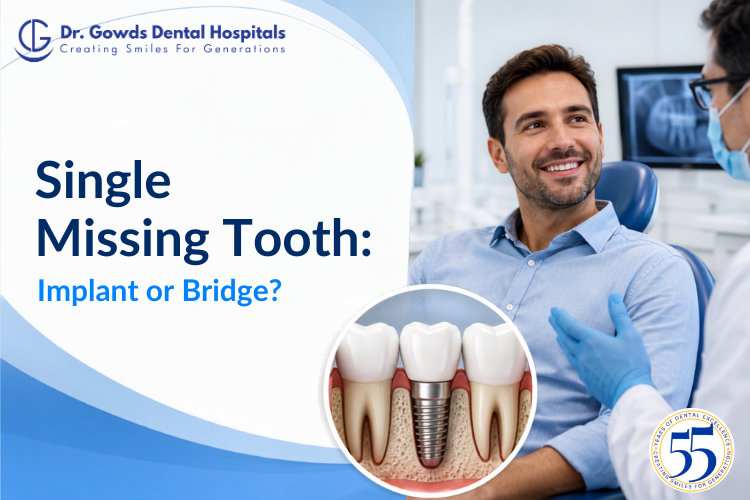
A Single Missing Tooth can affect more than your smile—it can influence your bite, chewing ability, speech, and long-term oral health. When replacing one missing tooth, dentists commonly recommend either a dental implant or a fixed dental bridge. In many cases, a dental implant is preferred because it replaces both the tooth root and the visible crown without requiring adjacent healthy teeth to be altered. However, the most suitable treatment depends on several factors, including bone health, the condition of neighboring teeth, oral hygiene, and individual treatment goals.
At Dr. Gowds Dental Hospitals, every patient receives a comprehensive evaluation to determine the most appropriate tooth replacement option based on their specific oral health needs.
Some people believe losing one tooth is not a major concern, especially if it is not visible while smiling.
However, leaving a Single Missing Tooth untreated may lead to:
Replacing the missing tooth helps maintain proper oral function and alignment.
The two most common fixed replacement options are:
A dental implant replaces:
It functions independently without relying on neighboring teeth.
A bridge replaces the missing tooth by attaching an artificial tooth to crowns placed on the adjacent natural teeth.
This means the neighboring teeth support the replacement tooth.
For many patients with a Single Missing Tooth, implants offer several long-term advantages.
One of the biggest advantages of implants is that adjacent teeth usually do not need to be reshaped.
A bridge often requires healthy supporting teeth to be prepared for crowns.
Preserving natural tooth structure is generally preferred whenever possible.
After a tooth is lost, the surrounding jawbone gradually begins to shrink because it no longer receives stimulation from the tooth root.
A dental implant functions like an artificial tooth root, helping maintain bone in that area.
A traditional bridge does not provide this stimulation.
Dental implants are designed to:
Because they stand independently, many patients describe them as feeling similar to natural teeth.
Since an implant is independent of adjacent teeth, daily cleaning is often similar to caring for a natural tooth.
Bridges require cleaning beneath the artificial tooth using specialized floss or cleaning aids.
With proper oral hygiene, regular dental visits, and good overall health, dental implants can provide long-term function.
Regular maintenance remains important regardless of the restoration type.
Although implants are frequently preferred, bridges remain an excellent treatment option in certain situations.
A bridge may be considered when:
The best choice depends on a thorough dental evaluation.
| Feature | Dental Implant | Dental Bridge |
| Replaces tooth root | ✔ Yes | ✘ No |
| Requires adjacent teeth | ✘ No | ✔ Yes |
| Helps maintain jawbone | ✔ Yes | ✘ No |
| Independent restoration | ✔ Yes | ✘ No |
| Alters healthy teeth | Usually no | Often yes |
| Cleaning | Similar to a natural tooth | Requires cleaning beneath the bridge |
Both options can successfully replace a missing tooth when selected appropriately.
Not necessarily.
Before recommending an implant, your dentist evaluates:
If additional procedures such as bone grafting are needed, these will be discussed during treatment planning.
Over time, several changes may occur:
Early replacement often helps prevent these complications.
Replacing a Single Missing Tooth is about more than restoring your smile—it helps maintain proper chewing, bite alignment, and long-term oral health. While both dental implants and bridges are reliable treatment options, implants are often recommended because they replace the missing tooth without relying on adjacent teeth and help preserve the underlying jawbone. However, the ideal solution depends on your individual needs, bone health, and the condition of neighboring teeth.
If you have a single missing tooth and would like to explore your replacement options, the experienced team at Dr. Gowds Dental Hospitals can provide a comprehensive evaluation and recommend the treatment that best supports your oral health and long-term smile.
Visit us at-
Dr gowds dental hospital Nanakramguda
Dr gowds dental hospital Gachibowli
Dr gowds dental hospital madhapur
Replacing a Single Missing Tooth helps prevent teeth from shifting, maintains chewing function, preserves bite alignment, and supports long-term oral health.
A dental implant usually preserves healthy neighboring teeth and helps maintain jawbone, whereas a bridge typically relies on adjacent teeth for support.
Yes. A bridge remains an effective treatment for many patients, particularly when adjacent teeth already require crowns or an implant is not the most suitable option.
Leaving a single missing tooth untreated may lead to tooth movement, bite changes, bone loss, and reduced chewing efficiency over time.
Your dentist will evaluate your jawbone, gums, neighboring teeth, bite, and overall oral health before recommending the most appropriate treatment option.
 Gachibowli Branch