

Schedule Appointment

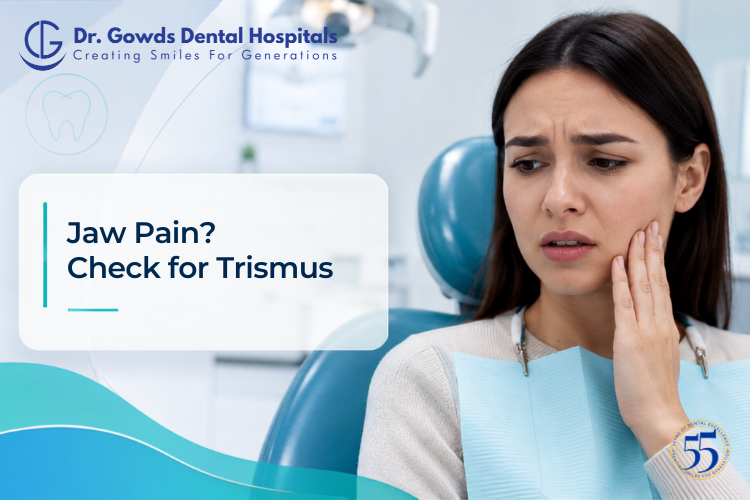
Trismus is a condition that limits how wide you can open your mouth due to stiffness or spasm of the jaw muscles. It may develop after wisdom tooth removal, dental injections, oral infections, jaw trauma, temporomandibular joint (TMJ) disorders, or certain medical conditions. While mild trismus often improves with treatment and jaw exercises, severe or persistent difficulty opening your mouth requires prompt dental evaluation to prevent complications with eating, speaking, and oral hygiene.
At Dr. Gowds Dental Hospitals, our specialists diagnose the underlying cause of trismus using advanced clinical evaluation and digital imaging, offering personalized treatment plans that restore comfortable jaw movement and improve oral function.
Trismus is a condition in which the muscles responsible for opening the jaw become tight, inflamed, or restricted, making it difficult to open the mouth normally.
It is commonly referred to as restricted mouth opening or jaw stiffness. Many people mistakenly call it “lockjaw,” although true lockjaw caused by tetanus is a different medical condition.
A healthy adult can usually open the mouth approximately 35–55 millimeters, or about the width of three fingers placed vertically between the upper and lower front teeth. If your mouth opening is significantly less than this or continues to worsen, you should seek professional evaluation.
Trismus is not a disease itself—it is usually a symptom of an underlying problem affecting the jaw muscles, joints, or surrounding tissues.
One of the most common causes of trismus is the removal of impacted wisdom teeth.
During surgery, the jaw muscles may become inflamed, causing temporary stiffness that usually improves within several days.
Local anesthesia administered near the jaw muscles can occasionally cause muscle irritation or spasm, leading to temporary trismus.
Most patients recover without complications.
Untreated dental abscesses or severe gum infections can spread into nearby tissues and muscles.
Swelling associated with infection often limits normal jaw movement.
Inflammation or dysfunction of the jaw joint can restrict mouth opening and cause pain while chewing or speaking.
Facial injuries, fractures, or direct trauma to the jaw muscles may result in trismus.
Chronic clenching and grinding overwork the jaw muscles, sometimes leading to muscle fatigue, spasms, and restricted movement.
Any surgical procedure involving the jaw muscles or surrounding tissues may temporarily reduce mouth opening during recovery.
Patients receiving radiation therapy for head and neck cancers may develop long-term trismus due to muscle fibrosis and scar tissue formation.
The severity of trismus varies depending on the underlying cause.
Common symptoms include:
Some patients experience symptoms on one side, while others develop bilateral jaw stiffness.
Dentists often classify trismus based on the amount of mouth opening.
The mouth opens slightly less than normal but daily activities remain manageable.
Eating, speaking, and brushing become increasingly difficult.
The patient can barely open the mouth, making eating, drinking, oral hygiene, and dental treatment extremely challenging.
Severe cases require immediate professional evaluation.
Not every case of trismus is an emergency, but certain symptoms require urgent dental or medical attention.
Seek immediate care if you experience:
These symptoms may indicate a spreading infection or serious jaw condition requiring immediate treatment.
Treatment depends entirely on what is causing the restricted jaw movement.
Managing the primary condition often resolves the trismus.
Examples include:
Your dentist may recommend:
Medication is selected based on the specific diagnosis.
Applying moist heat to the jaw muscles several times a day helps improve blood circulation and reduce muscle stiffness.
Gentle stretching exercises are one of the most effective treatments for mild to moderate trismus.
Your dentist may recommend:
Exercises should only be performed under professional guidance to avoid worsening the condition.
If TMJ dysfunction is responsible, treatment may include:
Rarely, surgery may be required if scar tissue, joint disorders, or structural abnormalities prevent normal jaw movement.
Mild trismus following dental treatment often improves within one to two weeks.
However, persistent or worsening jaw stiffness should never be ignored.
Delaying treatment may result in:
Early diagnosis significantly improves recovery.
Although not all cases can be prevented, these habits may reduce your risk:
Trismus is more than temporary jaw stiffness—it can interfere with eating, speaking, oral hygiene, and overall quality of life. Whether it develops after wisdom tooth removal, dental injections, infection, TMJ disorders, or trauma, identifying the cause early is essential for successful treatment.
Most cases improve with timely care, medications, jaw exercises, and management of the underlying condition. However, persistent or severe trismus should never be ignored, as delayed treatment can lead to long-term jaw dysfunction.
If you’re struggling to open your mouth fully, the experienced specialists at Dr. Gowds Dental Hospitals can provide a thorough evaluation and personalized treatment plan to help restore normal jaw function and improve your oral health.
Visit us at-
Dr gowds dental hospital Nanakramguda
Dr gowds dental hospital Gachibowli
Dr gowds dental hospital madhapur
Trismus is a condition that restricts normal mouth opening due to muscle stiffness, inflammation, jaw disorders, infection, or trauma.
Mild trismus usually improves within one to two weeks after wisdom tooth extraction with appropriate home care and jaw exercises.
Temporary trismus may improve on its own, but persistent or worsening symptoms require professional evaluation to identify and treat the underlying cause.
No. While trismus is commonly called lockjaw, true lockjaw is usually associated with tetanus, whereas trismus has many different dental and medical causes.
You should see a dentist if you cannot fully open your mouth, experience persistent jaw pain, develop swelling or fever, or have difficulty eating, speaking, or maintaining oral hygiene.
 Gachibowli Branch