

Schedule Appointment


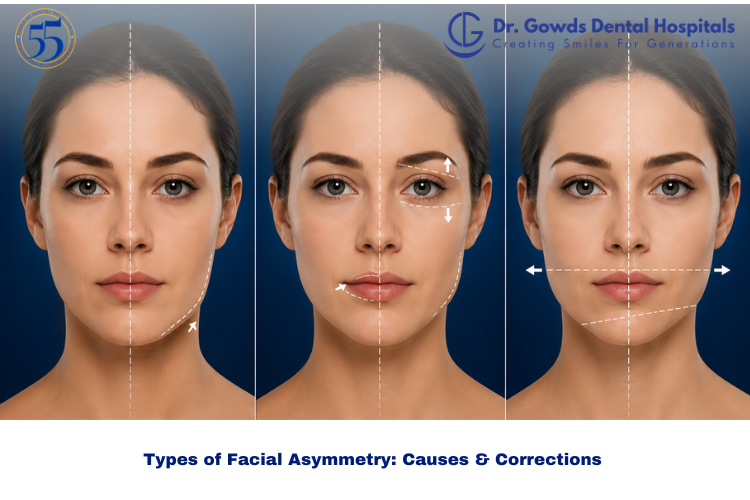
Facial asymmetry refers to differences between the left and right sides of the face. While minor asymmetry is normal and found in almost everyone, significant facial imbalance may be caused by underlying skeletal, soft tissue, or functional issues.
A useful way to classify facial asymmetry is into three broad patterns:
Some people may have features of more than one type.
Understanding which factors are contributing can help guide appropriate evaluation and treatment.
At Dr. Gowds Dental Hospitals, advanced facial analysis, digital imaging, orthodontic evaluation, and multidisciplinary treatment planning help identify the root cause of facial asymmetry and determine the most effective treatment approach.
Yes.Most people have minor differences between the two sides of their face.
Examples include:
These differences are generally harmless and do not require treatment.
Problems arise when asymmetry becomes significant, progressive, or associated with bite problems, jaw pain, speech difficulties, or aesthetic concerns.
Understanding the classification of facial asymmetry helps determine the most appropriate treatment plan.
Skeletal asymmetry occurs when the underlying facial bones develop unevenly.
This is often considered the most significant type of facial asymmetry because the imbalance originates from the facial skeleton itself.
The condition may involve:
When these structures develop unevenly, visible facial imbalance can occur.
Inherited growth patterns can influence facial development.
One side of the jaw may grow more than the other during adolescence.
Certain developmental disorders can affect facial bone formation.
Fractures or injuries may alter facial symmetry.
Abnormal growth of facial bones can create long-term asymmetry.
Treatment depends on severity.
Options may include:
At Dr. Gowds Dental Hospitals, CBCT imaging and digital treatment planning help accurately diagnose skeletal asymmetry and determine the most effective treatment pathway.
Soft tissue asymmetry occurs when the imbalance is caused by differences in facial muscles, fat distribution, skin thickness, or soft tissue volume rather than the underlying bones.
In many cases, the facial skeleton may be completely symmetrical.
The face may appear uneven because of differences in:
Some individuals naturally develop slight soft tissue differences.
Volume loss occurs differently on each side of the face.
Fluctuations in body weight can affect facial symmetry.
Soft tissue damage may alter facial appearance.
Overuse or underuse of facial muscles can create asymmetry.
Depending on the cause, treatment may involve:
Accurate diagnosis is important because soft tissue asymmetry requires a different approach from skeletal asymmetry.
Functional asymmetry occurs when the face appears uneven because of abnormal jaw function, bite discrepancies, or muscle activity.
The facial bones may be normal, but the way the jaw functions creates visible imbalance.
When the jaw shifts during movement or chewing, facial muscles may compensate unevenly.
Over time, this can make the face appear asymmetrical.
Improper bite alignment may force the jaw into an abnormal position.
Poor bite relationships can affect facial balance.
Jaw joint dysfunction often contributes to asymmetry.
Chronic grinding can alter muscle development.
Tooth loss can change bite mechanics and jaw positioning.
A persistent chewing preference may be associated with differences in muscle use, but the reason for the preference should also be considered.
Depending on the diagnosis, treatment may include:
At Dr. Gowds Dental Hospitals, functional asymmetry is evaluated using digital bite analysis and advanced orthodontic assessment.
Some causes of facial asymmetry can be treated or improved, while others represent normal or structural differences that may not require treatment.
The appropriate approach depends on whether the main contributor is skeletal, dental, functional, muscular, soft-tissue related, or a combination of factors.
For a broader overview of treatment options, see our facial asymmetry treatment in Hyderabad page.
Facial asymmetry is common, and minor differences between the two sides of the face are completely normal.
However, noticeable facial imbalance may be caused by one of three primary conditions:
Understanding the specific type of facial asymmetry is essential because each condition requires a different diagnostic and treatment approach.
If facial asymmetry affects your appearance, bite, jaw function, or confidence, a comprehensive evaluation at Dr. Gowds Dental Hospitals can help identify the cause and recommend the most appropriate treatment options.
Visit us at-
Dr gowds dental hospital Nanakramguda
Dr gowds dental hospital Gachibowli
Dr gowds dental hospital madhapur
The three primary types are skeletal asymmetry, soft tissue asymmetry, and functional asymmetry.
Skeletal asymmetry is often considered the most significant because it involves the underlying facial bones and may require orthodontic or surgical correction.
Invisalign can improve facial asymmetry when the cause is related to bite problems, tooth alignment, or functional jaw discrepancies.
No. Facial asymmetry may result from skeletal differences, soft tissue imbalances, muscle activity, aging, trauma, or bite-related issues.
Diagnosis typically involves clinical examination, digital smile analysis, orthodontic assessment, X-rays, and CBCT imaging to determine the underlying cause.

 Gachibowli Branch