

Schedule Appointment


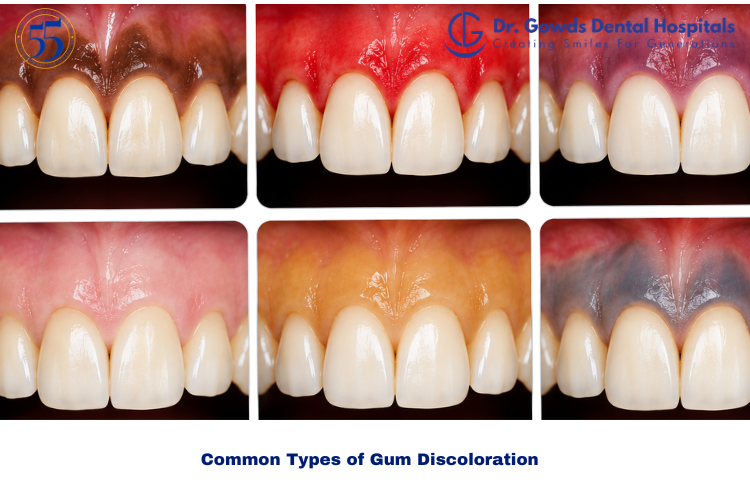
Gum discoloration refers to changes in the natural color of the gums. While healthy gums are typically pink, gums may appear brown, black, purple, gray, or dark because of natural pigmentation, smoking, certain medications, gum disease, or underlying health conditions.
The four most common types of gum discoloration are:
At Dr. Gowds Dental Hospitals, specialists evaluate gum discoloration using advanced diagnostic techniques to determine whether the pigmentation is harmless, cosmetic, or a sign of an underlying oral health problem.
Many people assume healthy gums must always be pink.
This is not entirely true.
Healthy gums may appear:
depending on natural melanin pigmentation.
The key indicator of gum health is not simply color but also:
Natural pigmentation is the most common and harmless form of gum discoloration.
Natural pigmentation occurs because of melanin production.
Melanin is the same pigment responsible for skin, hair, and eye color.
People with darker skin tones often have:
This pigmentation is completely normal and does not indicate disease.
No.
Natural gum pigmentation is a cosmetic variation rather than a medical condition.
However, some patients choose gum depigmentation procedures for aesthetic reasons.
At Dr. Gowds Dental Hospitals, laser gum depigmentation can help create a more uniform pink appearance for patients seeking cosmetic improvement.
Smoker’s melanosis is a form of gum discoloration caused by tobacco use.
Nicotine and tobacco stimulate melanin-producing cells in the gums.
As a result, the gums become progressively darker over time.
This condition is commonly seen in:
The pigmentation itself is usually harmless.
However, tobacco use significantly increases the risk of:
In many cases, gum pigmentation may gradually lighten after smoking cessation.
For patients seeking faster cosmetic improvement, laser gum depigmentation may be considered.
Certain medications can alter the color of gum tissues.
Some drugs affect:
This can lead to noticeable color changes.
Not always.
However, any unexplained change in gum color should be evaluated by a dental professional to rule out other conditions.
At Dr. Gowds Dental Hospitals, detailed medical history assessments help determine whether medications contribute to gum pigmentation.
Gum disease is one of the most important causes of abnormal gum color changes.
Unlike natural pigmentation, this form of discoloration usually indicates inflammation or infection.
When bacteria accumulate around the gums, inflammation develops.
This increases blood flow and tissue changes, causing the gums to appear:
As periodontal disease progresses, discoloration may become more pronounced.
Gums bleed during brushing or flossing.
Inflamed tissues become enlarged and tender.
Persistent bad breath often accompanies gum disease.
The gums pull away from the teeth.
Advanced disease may cause loose teeth.
Unlike natural pigmentation, gum disease-related discoloration is a sign of active infection.
Without treatment, it can lead to:
Professional periodontal treatment is often necessary.
Although the four categories above are the most common, other causes may include:
Injuries may create localized dark spots.
Dental filling particles embedded in gum tissue can cause blue-gray patches.
Certain diseases may affect gum pigmentation.
Rarely, abnormal dark lesions may indicate serious pathology.
Any rapidly changing, painful, or unusual pigmentation should be evaluated promptly.
Treatment depends entirely on the underlying cause.
Usually requires no treatment.
Laser gum depigmentation can improve the appearance of naturally dark gums for patients seeking aesthetic enhancement.
Not all gum discoloration indicates disease.
In many cases, darker gums are simply the result of natural pigmentation and require no treatment.
However, gum discoloration can also occur because of smoking, medications, or gum disease.
Understanding the different types of gum discoloration helps determine whether the color change is harmless, cosmetic, or a sign of an underlying oral health issue.
If you notice unusual changes in gum color, a professional evaluation at Dr. Gowds Dental Hospitals can help identify the cause and recommend the most appropriate treatment.
Visit us at-
Dr gowds dental hospital Nanakramguda
Dr gowds dental hospital Gachibowli
Dr gowds dental hospital madhapur
Yes. Natural melanin pigmentation can cause healthy gums to appear brown or dark, especially in individuals with darker skin tones.
Yes. Certain medications can lead to brown, blue-gray, or dark pigmentation changes in the gums.
Sometimes. Red, purple, or swollen gums accompanied by bleeding may indicate gum disease and require treatment.
Yes. Treatment depends on the cause and may include periodontal therapy, smoking cessation, medication review, or cosmetic laser gum depigmentation.

 Gachibowli Branch