

Schedule Appointment


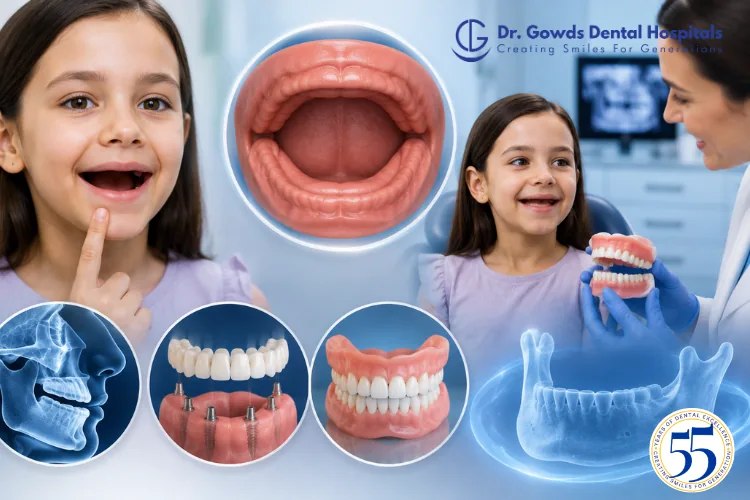
Teeth normally develop in stages before eventually appearing in the mouth. In rare situations, teeth may fail to develop altogether. When a person has a complete absence of naturally developing teeth, the condition is known as anodontia.
Anodontia is different from losing teeth because of cavities, gum disease, trauma, or extraction. In anodontia, the teeth do not develop in the first place.
Because teeth play an important role in chewing, speech, facial support, and oral development, complete absence of teeth can have a significant impact on everyday life. Treatment therefore focuses not only on replacing missing teeth but also on supporting oral function, facial development, comfort, and long-term dental health.
At Dr Gowds Dental Hospitals, patients with congenital absence of teeth can undergo a detailed dental evaluation to understand their individual condition and discuss appropriate tooth-replacement options.
Anodontia is a rare developmental dental condition characterized by the complete absence of naturally developing teeth.
The condition can involve both:
True anodontia means that all teeth fail to develop.
This makes it different from conditions in which only some teeth are absent.
Not all congenital absence of teeth is called anodontia.
Dental professionals use different terms depending on how many teeth are missing.
Complete absence of teeth.
A smaller number of teeth are congenitally absent.
Multiple teeth are congenitally absent, but some teeth still develop.
These conditions fall within the broader group of developmental tooth-number abnormalities.
The distinction is important because treatment planning depends on how many teeth are present, which teeth are missing, and how the jaws and remaining oral structures have developed.
True anodontia is extremely rare.
More limited forms of congenital tooth absence are considerably more common than complete anodontia.
When all teeth appear to be absent, dental imaging and clinical assessment are important to confirm whether teeth truly failed to develop or whether they are unerupted, impacted, or otherwise hidden within the jaws.
The exact cause of anodontia is not always identifiable.
Tooth development is controlled by a complex interaction between genetic instructions and biological processes.
Genetic factors can influence whether tooth development occurs normally.
In some individuals, complete or extensive absence of teeth may occur as part of a broader genetic condition.
For this reason, a patient with complete or extensive congenital absence of teeth may require assessment beyond simply examining the visible mouth.
Genetic factors can play an important role in disorders involving tooth development.
A family history of congenitally missing teeth may therefore be relevant when a dentist evaluates a patient with extensive tooth absence.
However, not every person with missing teeth has an identifiable family history or a known inherited condition.
Genetic assessment may be considered when the clinical pattern suggests that it could provide useful information.
Extensive absence of teeth can sometimes occur in association with broader developmental or genetic disorders.
For example, abnormalities affecting structures involved in tooth development may occur alongside changes involving hair, skin, nails, or sweat glands.
This does not mean that every person with congenital missing teeth has a systemic condition.
However, when tooth absence is extensive, unusual, or accompanied by other physical findings, a comprehensive medical and dental evaluation may be appropriate.
Teeth perform several functions beyond creating a complete smile.
Complete tooth absence can affect:
Without teeth, breaking down food becomes significantly more difficult.
Teeth contribute to the production of certain speech sounds. Their absence may affect pronunciation.
Teeth and the surrounding bone contribute to the shape and support of the lower face.
Changes in appearance can influence how a person feels about smiling or interacting socially.
In children, the absence of teeth can affect the normal relationship between the developing jaws and oral structures.
Teeth and the bone supporting them develop together.
When teeth are absent, the parts of the jaw that normally support tooth roots may develop differently.
This becomes particularly important when future dental implants are being considered.
Implants require sufficient bone for stable placement. A patient who has never developed teeth may therefore require detailed evaluation of bone quantity and anatomy before implant treatment.
There is no single treatment that is suitable for everyone with anodontia.
Treatment planning depends on:
The primary objective is to restore oral function and provide an appropriate replacement for the missing teeth.
Dentures can replace missing teeth without requiring implant surgery.
For patients with complete tooth absence, complete dentures may provide:
In children, specially designed removable prostheses may sometimes be used during growth and development.
These appliances may need to be adjusted or replaced as the jaws grow.
Dental implants can provide support for replacement teeth in appropriately selected patients.
An implant is placed into the jawbone and functions as a foundation for a dental restoration.
However, implant treatment requires careful assessment in patients with anodontia because:
For growing children, permanent implant placement is generally approached differently from treatment in adults because the jaws continue to develop.
Orthodontic treatment can sometimes form part of comprehensive treatment planning when some teeth are present and others are absent.
The orthodontist may help:
In complete anodontia, there are no natural teeth to move orthodontically, so treatment is instead focused on prosthetic rehabilitation and jaw development.
The consequences vary depending on the individual’s age and circumstances.
In adults, untreated complete tooth absence can make eating and speaking difficult and may affect facial appearance.
In children, the absence of teeth can affect oral function and facial development.
Treatment does not necessarily need to be permanent from the beginning. A staged approach may be used, particularly in growing patients.
The goal is to provide appropriate support at each stage of development.
Teeth provide structural support to the lips and lower face.
Complete absence of teeth can alter the appearance of facial proportions because the normal support provided by teeth and the alveolar bone is absent.
Appropriate prosthetic rehabilitation can help restore some of this support.
The objective is not simply to create the appearance of teeth but to establish an appropriate relationship between the replacement teeth, lips, jaw, and facial structures.
Anodontia is a rare developmental condition in which teeth fail to develop completely. It is fundamentally different from losing teeth after they have erupted.
Because teeth influence chewing, speech, facial support, and oral development, complete tooth absence can have significant functional and aesthetic consequences.
Diagnosis often requires clinical examination and dental imaging to confirm that teeth are genuinely absent rather than unerupted or impacted.
Treatment is individualized. Dentures and other removable prostheses may provide functional replacement, while selected adults may be candidates for implant-supported rehabilitation. In growing children, temporary solutions and careful monitoring are often important because the jaws continue to develop.
The most important step is obtaining an accurate diagnosis and planning treatment around the patient’s stage of development rather than treating tooth absence as a simple cosmetic issue.
At Dr Gowds Dental Hospitals, a comprehensive dental assessment can help patients understand their condition and explore appropriate options for restoring oral function, comfort, and appearance.
Visit us at-
Dr gowds dental hospital Nanakramguda
Dr gowds dental hospital Gachibowli
Dr gowds dental hospital madhapur
Anodontia is a rare developmental dental condition in which teeth fail to develop completely. It can involve both primary and permanent teeth.
Anodontia refers specifically to complete congenital absence of tooth development. Having only some teeth missing from birth is generally classified under other developmental tooth-number conditions.
Anodontia means all teeth are absent because they failed to develop. Hypodontia refers to the congenital absence of a smaller number of teeth.
Anodontia is often associated with genetic or developmental factors, although an exact cause may not always be identified.
Genetic factors can contribute to disorders involving tooth development. However, the inheritance pattern and cause vary between individuals.
Not always. Some patients may have sufficient bone, while others may require bone augmentation before or as part of implant treatment.
Yes. Removable dentures can replace missing teeth and may improve chewing, speech, facial support, and appearance.
 Gachibowli Branch