

Schedule Appointment


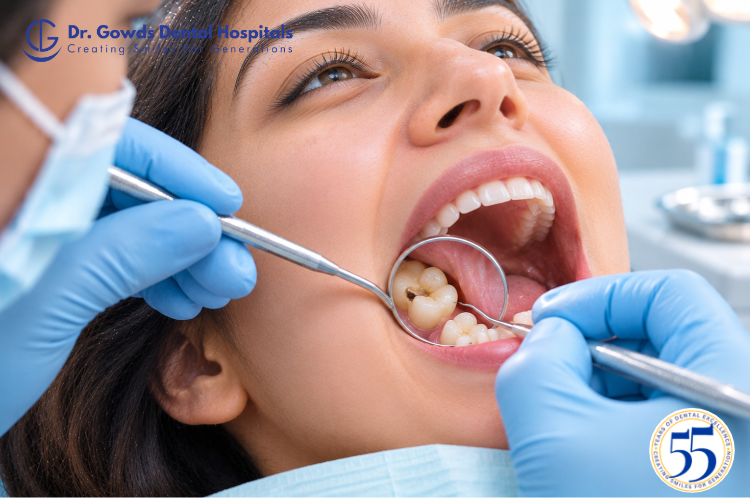
Wisdom tooth cavity treatment can involve either restoring the tooth with a filling or removing the tooth, depending on its position, condition, accessibility, and overall suitability for treatment.
A cavity in a wisdom tooth can be confusing because not every wisdom tooth needs to be removed simply because it has decay. At the same time, filling every wisdom tooth is not necessarily the right approach.
The decision is best made after a dental examination, where the dentist can assess the tooth and determine whether restoring it or removing it makes more sense.
At Dr Gowds Dental Hospitals in Hyderabad, patients can discuss their wisdom tooth concerns and understand the available treatment options before deciding on the next step.
Looking for wisdom tooth cavity treatment in Hyderabad?
A wisdom tooth is located at the very back of the mouth. Because of its position, cleaning around it can sometimes be difficult, particularly when the tooth is partially erupted or positioned in a way that makes access challenging.
When a cavity develops, the dentist first needs to understand the extent and location of the affected area.
Some of the factors that may be considered include:
This assessment helps determine the most suitable approach to wisdom tooth cavity treatment.
Yes, a wisdom tooth may sometimes be treated with a filling when the tooth is considered suitable for restoration.
A filling involves removing the decayed portion of the tooth and restoring the affected area with a dental filling material.
A dentist may consider a filling when:
The key point is that having a cavity does not automatically mean a wisdom tooth must be removed.
The tooth’s position and overall condition matter just as much as the presence of the cavity.
In some situations, removing the wisdom tooth may be considered instead of placing a filling.
This may happen when the tooth is difficult to access, has extensive structural damage, or is positioned in a way that makes long-term maintenance challenging.
Factors that may lead a dentist to discuss removal include:
Wisdom tooth removal is therefore not simply a response to the word “cavity.” It is a decision based on the condition and position of the individual tooth.
Understanding the basic difference can make the decision easier.
A filling focuses on keeping the existing tooth.
The dentist removes the decayed portion and restores the affected area. This approach may be considered when the tooth is accessible, structurally suitable, and practical to maintain.
Removal involves taking the affected wisdom tooth out rather than restoring it.
This may be discussed when the tooth is difficult to restore, difficult to maintain, or has other factors that make keeping it less practical.
| Factor | Wisdom Tooth Filling | Wisdom Tooth Removal |
| Main objective | Preserve the tooth | Remove the affected tooth |
| Suitable when | Tooth can be restored | Tooth is difficult or unsuitable to restore |
| Tooth position | Accessible | May be difficult to access |
| Healthy structure | Adequate structure remains | May be insufficient for practical restoration |
| Maintenance | Requires continued cleaning | Tooth is no longer present |
| Decision | Based on tooth condition | Based on overall suitability for removal |
The choice between the two should be based on an individual dental assessment rather than a general rule.
The location of a wisdom tooth can play an important role in wisdom tooth cavity treatment.
A fully erupted wisdom tooth that can be reached easily with a toothbrush and dental instruments may be easier to evaluate and restore.
A partially erupted or awkwardly positioned wisdom tooth can present a different treatment situation. Its location may affect access, cleaning, restoration, and ongoing maintenance.
This is why two people with a cavity in their wisdom teeth may receive different treatment recommendations.
A common mistake is to wait because the tooth does not currently feel uncomfortable.
However, the absence of noticeable discomfort does not tell you whether a cavity needs attention. A dental examination can provide a clearer understanding of the tooth’s condition.
Delaying an evaluation can also make it harder to determine whether a simple restoration remains practical.
If you notice a cavity, food getting trapped around a wisdom tooth, sensitivity, discomfort, or another unusual change, consider arranging a dental evaluation rather than deciding on filling or removal yourself.
The exact process depends on whether the tooth is being restored or removed.
The dentist generally:
The dentist may also discuss how to keep the area clean and what to monitor afterward.
The dentist first evaluates the tooth and plans the removal based on its position and condition.
The procedure and aftercare can vary depending on the individual case. Your dentist can explain what to expect before proceeding.
If you are asking, “Should I fill or remove my wisdom tooth?”, consider the decision as a combination of several factors rather than focusing only on the cavity.
A dentist will typically assess:
There is no single answer that applies to every wisdom tooth.
A tooth that can be restored and maintained may be approached differently from one that is difficult to access or restore.
Once a wisdom tooth is retained, maintaining good oral hygiene becomes particularly important.
Practical habits include:
Your dentist can also advise you on an appropriate cleaning routine based on the position of your wisdom tooth.
Searching online for “wisdom tooth filling or removal” can help you understand the basic options, but it cannot determine which option is suitable for a specific tooth.
The same type of cavity can lead to different treatment approaches depending on the tooth’s position, accessibility, structure, and overall condition.
Rather than deciding based only on symptoms, a dental examination allows the dentist to assess the actual tooth and explain the available options.
A cavity in a wisdom tooth does not automatically mean that the tooth needs to be removed.
In some cases, wisdom tooth cavity treatment may involve a filling when the tooth is suitable for restoration and maintenance. In other situations, removal may be discussed when the tooth is difficult to restore or maintain.
The right decision depends on the individual tooth rather than a one-size-fits-all rule.
If you have a wisdom tooth cavity in Hyderabad, Dr Gowds Dental Hospitals offers dental consultations across its Nanakramguda, Gachibowli, Madhapur, koti branches.
Have a wisdom tooth cavity and unsure whether you need a filling or removal? Consult Dr Gowds Dental Hospitals in Hyderabad to understand your treatment options and take the next step toward appropriate dental care.
It depends on the condition, position, accessibility, and restorability of the wisdom tooth. A dentist can evaluate these factors and explain whether filling or removal is more appropriate.
A wisdom tooth can sometimes be restored with a filling when the tooth is accessible and has enough healthy structure for restoration. The suitability of a filling depends on the individual tooth.
Removal may be considered when the tooth is difficult to access, difficult to maintain, extensively damaged, or otherwise unsuitable for practical restoration.
No. The presence of decay alone does not determine the treatment. The dentist also considers the tooth’s position, condition, accessibility, and whether it can be reasonably restored and maintained.
Depending on the individual situation, options may include restoring the tooth with a filling or discussing wisdom tooth removal. A dental examination helps determine which option is suitable.
It is better not to make a treatment decision based only on whether the tooth hurts. A dental examination can determine the condition of the cavity and whether treatment should be considered.
The dentist can assess the cavity, remaining tooth structure, tooth position, accessibility, and overall condition to determine whether a filling is a practical option.

 Gachibowli Branch