

Schedule Appointment

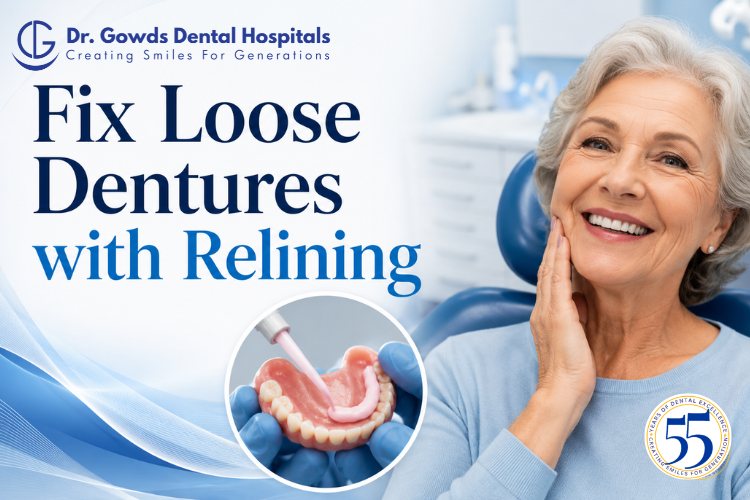
Denture relining is a dental procedure that reshapes the inner surface of a denture so it fits comfortably against your gums after they have changed over time. As the jawbone and gum tissue naturally shrink following tooth loss, dentures can become loose, unstable, and uncomfortable. Relining adds new material to the inside of the denture to improve its fit without replacing the entire appliance. If your dentures slip while eating or speaking, cause sore spots, or no longer fit properly, denture relining may be the ideal solution.
At Dr. Gowds Dental Hospitals, our prosthodontists provide customized denture relining services to restore comfort, improve stability, and help patients enjoy better chewing and speaking.
Denture relining is the process of resurfacing the tissue-facing side of a denture with new material to match the current shape of your gums and jaw.
When dentures are first made, they fit the gums precisely. However, after tooth loss, the jawbone gradually shrinks in a natural process called bone resorption. As this happens, the denture no longer fits as it once did.
Relining fills the gap between the denture and the gums, restoring a snug and secure fit.
Importantly, denture relining does not change the artificial teeth or the outer appearance of the denture—it only improves the internal fit.
Even well-made dentures may eventually require denture relining because your mouth continues to change over time.
Common reasons include:
Without relining, loose dentures can interfere with daily activities and increase the risk of oral problems.
If your dentures no longer feel secure, they may need professional evaluation.
Common signs include:
If you notice any of these symptoms, your dentist may recommend denture relining.
Many patients wonder why dentures become loose even if they have taken good care of them.
The main reason is bone resorption.
After teeth are lost, the jawbone no longer receives stimulation from natural tooth roots. Over time, the bone slowly shrinks.
As the gums and bone change shape, the denture no longer fits accurately.
This process is completely normal and occurs gradually over many years.
There are different types of denture relining, and your dentist will recommend the most appropriate option based on your oral health and the condition of your dentures.
Hard relining uses durable acrylic material similar to the original denture base.
It is generally recommended for patients who have healthy gums and require a long-lasting solution.
Benefits
Hard relines often last several years with proper care.
Soft relining uses a flexible cushioning material placed inside the denture.
It is often recommended for patients with:
Benefits
Soft liners usually require more frequent replacement than hard liners.
Temporary relines use medicated or soft materials during the healing phase after extractions or oral surgery.
They help improve comfort while the gums continue to heal before a permanent reline is performed.
The denture relining procedure is usually straightforward.
Your dentist evaluates:
An impression is taken using your existing denture.
This records the current shape of your gums for an accurate fit.
The impression is used to add new lining material to the denture.
Depending on the type of reline, this may be completed in the dental office or dental laboratory.
Once the relined denture is ready, your dentist checks:
Minor adjustments may be made to ensure optimal function.
The time required depends on the type of denture relining.
Some chairside relines can be completed on the same day.
Laboratory relines may require one or two days depending on the complexity of the case.
Your dentist will explain the expected timeline before treatment begins.
Professional denture relining offers several important advantages.
A properly fitting denture reduces sore spots and pressure on the gums.
Relined dentures move less during eating and speaking.
A secure fit allows patients to chew more efficiently and comfortably.
Loose dentures can affect pronunciation.
Improved stability often results in better speech.
Many patients rely less on denture adhesives after relining.
Relining helps maintain the function of dentures that are otherwise in good condition.
Although the terms are sometimes confused, they are different procedures.
| Denture Relining | Denture Rebasing |
| Replaces only the inner lining | Replaces the entire denture base |
| Artificial teeth remain unchanged | Artificial teeth are reused with a new base |
| Used when denture base is in good condition | Used when the denture base is damaged or weakened |
| Less extensive procedure | More comprehensive reconstruction |
Your dentist will recommend the appropriate treatment based on the condition of your denture.
Denture relining is a simple yet highly effective procedure that restores the fit, comfort, and stability of dentures as your gums and jawbone naturally change over time. Instead of replacing an otherwise well-functioning denture, relining reshapes the inner surface to match your current oral anatomy, improving chewing, speech, and overall confidence.
Ignoring loose dentures can lead to sore gums, difficulty eating, and reduced quality of life. If your dentures no longer fit comfortably, a professional evaluation can determine whether denture relining is the right solution.
At Dr. Gowds Dental Hospitals, our experienced prosthodontists provide customized denture relining treatments designed to improve comfort, extend the life of your dentures, and restore your ability to eat, speak, and smile with confidence.
Visit us at-
Dr gowds dental hospital Nanakramguda
Dr gowds dental hospital Gachibowli
Dr gowds dental hospital madhapur
Denture relining is a procedure that adds new material to the inside surface of a denture to improve its fit after changes in the gums and jawbone.
Many dentures benefit from evaluation every 2 to 3 years, but the timing depends on changes in your mouth and how well the dentures fit.
No. The procedure is generally painless. It is designed to improve comfort by eliminating pressure points and creating a better-fitting denture.
Yes. If the denture is otherwise in good condition, denture relining can often restore its fit and stability without the need for a completely new denture.
Home relining kits are not recommended because they may cause an improper fit, gum irritation, or damage to the denture. Professional denture relining provides a more accurate, comfortable, and long-lasting result.
 Gachibowli Branch