

Schedule Appointment

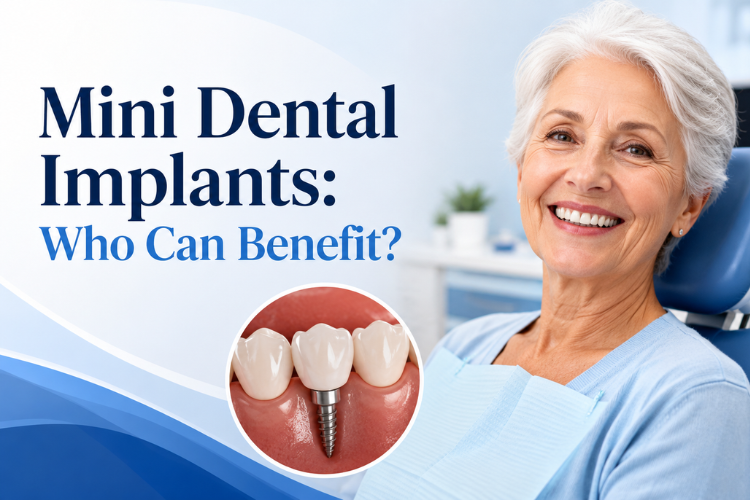
Mini Dental Implants are smaller-diameter dental implants designed to replace missing teeth or stabilize loose dentures when traditional implants may not be suitable. They are often recommended for patients with limited jawbone volume, those seeking a less invasive procedure, or individuals who need improved denture stability. While they are an excellent solution for selected cases, they are not the right option for everyone. A thorough dental examination and advanced imaging help determine whether mini dental implants or conventional implants are the better choice.
At Dr. Gowds Dental Hospitals, our implant specialists carefully evaluate each patient’s oral health, bone quality, and treatment goals to recommend the most appropriate implant solution.
Mini Dental Implants are titanium implant posts that are smaller in diameter than conventional dental implants.
Like traditional implants, they are surgically placed into the jawbone and act as artificial tooth roots. Once integrated with the bone, they support dentures, crowns, or other dental restorations.
Because of their smaller size, mini dental implants can often be placed with a less invasive procedure and may require less healing time in suitable patients.
Although both options replace missing teeth, there are important differences.
| Mini Dental Implants | Traditional Dental Implants |
| Smaller diameter | Larger diameter |
| Less invasive placement | Standard surgical placement |
| May require less bone | Usually requires adequate bone volume |
| Often used for denture stabilization | Suitable for single or multiple tooth replacement |
| Faster recovery in many cases | Longer healing period in some cases |
| Best for selected situations | Suitable for a wider range of restorative cases |
The choice depends on your oral health, jawbone condition, and treatment needs.
Mini Dental Implants are recommended only after careful evaluation by an implant dentist.
They may be suitable for:
One of the most common uses of mini dental implants is to secure removable dentures.
Implant-supported dentures are generally:
Some patients do not have enough bone to support standard implants.
In selected cases, mini dental implants may provide a suitable solution without extensive bone grafting.
Older adults who are medically fit and have difficulty wearing conventional dentures may benefit from improved denture stability with mini dental implants.
Age alone is not a limiting factor.
Because of their smaller size, mini dental implants may involve:
Mini dental implants may sometimes be considered for replacing smaller teeth, particularly in areas where space is limited.
Your dentist will determine whether they provide adequate long-term support.
Although Mini Dental Implants offer many benefits, conventional implants remain the preferred option for many patients.
Traditional implants may be recommended when:
Your implant specialist will recommend the option that offers the best long-term outcome.
There are several advantages of Mini Dental Implants for appropriately selected patients.
The smaller implant size often reduces surgical trauma.
Loose dentures become significantly more secure during eating and speaking.
Many patients experience quicker recovery compared with conventional implant surgery.
Stabilized dentures reduce irritation and improve confidence.
Patients often find it easier to eat a wider variety of foods.
Better-fitting dentures contribute to improved appearance and speech.
Understanding the procedure helps patients know what to expect.
Your dentist evaluates:
A CBCT scan may be recommended for detailed treatment planning.
The implant positions are digitally planned to maximize stability and safety.
The treatment area is numbed for patient comfort.
The Mini Dental Implants are carefully inserted into the jawbone using precise surgical techniques.
Because they are smaller, the procedure is often less invasive than standard implant placement.
Depending on the treatment plan, the implants may support:
In some cases, dentures can be stabilized on the same day, while other cases may require a healing period before the final restoration.
Recovery is generally straightforward.
Patients may experience:
These symptoms usually improve within a few days.
Your dentist may recommend:
Yes.
Like traditional implants, Mini Dental Implants are intended to be a long-term tooth replacement solution.
Their longevity depends on:
With proper care, they can function successfully for many years.
Although effective, Mini Dental Implants are not suitable for every patient.
Limitations may include:
Your dentist will recommend the option that provides the best long-term stability.
Mini Dental Implants are an excellent treatment option for carefully selected patients, particularly those seeking greater denture stability, a minimally invasive procedure, or a solution for limited jawbone volume. While they are not a replacement for conventional implants in every situation, they offer significant benefits when recommended for the right clinical indications.
Choosing between mini and traditional implants requires a comprehensive examination, digital imaging, and individualized treatment planning. The best option is the one that provides lasting function, comfort, and oral health for your specific needs.
If you are considering dental implants or are frustrated with loose dentures, schedule a consultation at Dr. Gowds Dental Hospitals. Our implant specialists will evaluate your oral health and recommend the most suitable treatment to help restore your smile and confidence.
Visit us at-
Dr gowds dental hospital Nanakramguda
Dr gowds dental hospital Gachibowli
Dr gowds dental hospital madhapur
Mini Dental Implants are smaller-diameter titanium implants used to replace missing teeth or stabilize dentures in selected patients.
Mini dental implants are durable for appropriate clinical situations, but traditional implants are generally preferred for replacing larger teeth or supporting restorations that must withstand greater chewing forces.
Patients with loose dentures, limited jawbone volume, or those seeking a less invasive implant procedure may be suitable candidates after a professional evaluation.
With good oral hygiene, healthy gums, and regular dental care, Mini Dental Implants can last for many years.
The procedure is typically performed under local anesthesia, making it comfortable for most patients. Mild soreness or swelling after treatment usually subsides within a few days.
 Gachibowli Branch