

Schedule Appointment


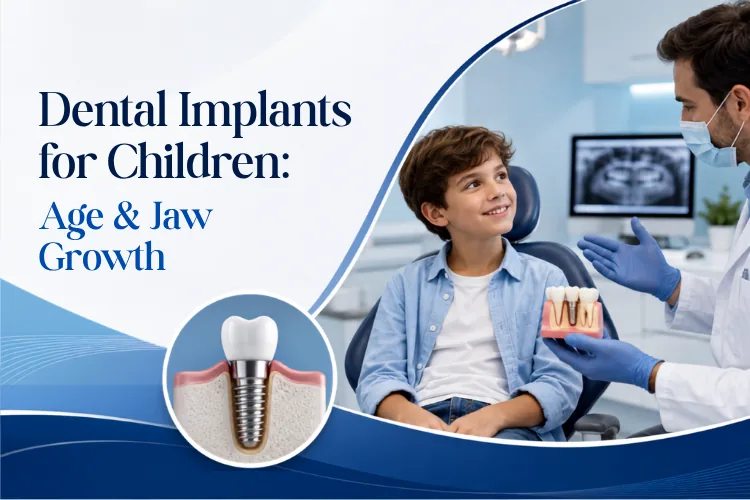
When a child loses a permanent tooth, parents naturally want to know how quickly it can be replaced. A dental implant may seem like an obvious long-term solution because implants are designed to replace missing teeth and provide stable support for a dental crown.
However, dental implants for children require a different approach from implant treatment in fully grown adults.
The main reason is growth.
A child’s jawbones and facial structures continue developing throughout childhood and adolescence. Placing an implant while the jaw is still growing can create challenges because an implant behaves differently from a natural tooth as the surrounding structures develop.
This does not mean that a child with a missing tooth cannot receive appropriate treatment. Instead, the dentist may recommend protecting the space, maintaining appearance and function, and monitoring development until a more suitable time for permanent tooth replacement.
At Dr. Gowds Dental Hospitals, treatment planning for children with missing teeth should take into account dental development, jaw growth, surrounding teeth, bone condition, and the child’s long-term oral health.
In general, dental implants are not routinely placed in children whose jaws are still growing.
An implant is anchored into the jawbone and is intended to remain relatively stable. Natural teeth, however, continue to move and adapt as the jaw develops.
If an implant is placed before growth is complete, the surrounding jaw and teeth may continue changing while the implant remains in its original position.
This can potentially affect:
Therefore, dentists generally consider whether a child has reached sufficient skeletal and dental maturity before recommending permanent implant treatment.
This is one of the most important points parents should understand.
A dental implant replaces the root portion of a missing tooth and integrates with the jawbone.
Unlike a natural tooth, the implant does not have the same periodontal ligament that allows a natural tooth to adapt as the surrounding jaw changes.
If the jaw continues to grow after implant placement, the surrounding natural teeth and tissues may change position while the implant remains relatively stationary.
This can potentially make the implant appear:
The extent of these changes varies between individuals, which is why growth assessment is an important part of implant planning for younger patients.
There is no single age that automatically makes every patient suitable for dental implants.
People often hear that dental implants should be placed only after a particular birthday, but chronological age is not the only consideration.
The dentist may assess:
A younger patient may mature at a different rate from another person of the same age.
Therefore, the question is not simply, “How old is the child?”
A more useful question is:
“Has the patient’s jaw and dental development reached a stage where an implant can be planned predictably?”
Teenagers are closer to adulthood, but that does not automatically mean they are ready for implant treatment.
Some adolescents may have nearly completed growth, while others may still be developing.
For this reason, implants in teenagers require careful individual assessment.
In selected circumstances, implant treatment may be considered when growth is sufficiently complete and the clinical conditions are appropriate. In other cases, delaying the implant and using an interim solution may be safer for long-term aesthetics and function.
A dentist may work with other dental specialists, such as an orthodontist, when tooth position and jaw development need to be considered before implant placement.
Children can lose permanent teeth for several reasons.
These may include:
A fall, sports injury, or accident can damage or completely dislodge a permanent tooth.
Advanced decay can sometimes result in the loss of a permanent tooth when the tooth cannot be predictably restored.
Some children are born with missing permanent teeth.
This condition may affect one or more teeth.
Severe infection or extensive structural damage may occasionally result in the loss of a permanent tooth.
Certain developmental or structural problems can also affect the presence or long-term survival of permanent teeth.
The appropriate treatment depends on why the tooth is missing and the child’s stage of development.
Losing a permanent tooth does not necessarily mean that an implant should be placed immediately.
The first step is determining whether the tooth can be saved.
If a permanent tooth has been knocked out because of trauma, urgent dental evaluation is important because in some situations the tooth may be repositioned and managed rather than replaced with an implant.
If the tooth cannot be saved, the dentist then needs to consider how to manage the space during growth.
The treatment plan may focus on:
When a child is not ready for a permanent implant, dentists can consider temporary or developmental solutions.
The appropriate option depends on the child’s age, number of missing teeth, location of the gap, bite, and dental development.
A removable appliance may be used to replace a missing visible tooth temporarily.
It can help with appearance and, in selected situations, function.
If a permanent tooth is missing, maintaining appropriate space can be important for future treatment.
The dentist may monitor the area to prevent unwanted movement of neighboring teeth.
In some situations, orthodontic treatment may be used to manage the space.
Depending on the individual case, the space may be maintained, opened, or closed as part of a broader treatment plan.
A temporary restoration may be considered while the child’s jaw continues developing.
The objective is to provide an appropriate short-term solution without committing to a permanent implant too early.
Front teeth contribute to the way the lips and tongue interact during speech.
A missing front tooth may therefore influence the pronunciation of certain sounds in some children.
Children may adapt over time, but the effect varies according to the child’s age and the location of the missing tooth.
A dentist can determine whether temporary replacement would be beneficial.
The effect depends on the tooth that has been lost.
A missing back tooth may have a greater influence on chewing function than a missing tooth in some other areas.
Children may naturally adjust their chewing pattern when a tooth is missing.
The dentist can evaluate whether the missing tooth is affecting the child’s bite or chewing and whether temporary intervention is appropriate.
The primary concern is that the jaw and surrounding teeth may continue developing after the implant has been placed.
The implant itself is designed to remain integrated with the bone.
As the surrounding structures change, the implant-supported crown may no longer occupy the same relative position as the neighboring natural teeth.
This can potentially create:
These risks are why growth assessment is particularly important in younger patients.
Dental implants for children require careful consideration because children’s jaws and facial structures are still developing.
A missing permanent tooth does not necessarily mean that an implant should be placed immediately. In many growing children, the priority is to preserve the space, maintain oral function and appearance, and monitor dental development until permanent replacement can be considered.
Teenagers may be closer to implant eligibility, but age alone does not determine whether treatment is appropriate. Growth completion, bone condition, dental development, gum health, bite, and the individual circumstances all need to be considered.
For parents, the most important step is not deciding on an implant immediately. It is obtaining an appropriate dental evaluation and understanding the options available at the child’s current stage of development.
At Dr. Gowds Dental Hospitals, individualized assessment can help determine whether a child needs temporary management, orthodontic care, monitoring, or eventual implant-based tooth replacement.
Visit us at-
Dr gowds dental hospital Nanakramguda
Dr gowds dental hospital Gachibowli
Dr gowds dental hospital madhapur
Dental implants are generally not routinely placed in children whose jaws are still growing. Treatment timing depends on growth, dental development, bone condition, and the individual clinical situation.
There is no universal age that applies to everyone. Implant placement is generally considered after sufficient jaw growth has occurred rather than simply when a patient reaches a particular birthday.
Some teenagers may eventually become candidates, but growth completion must be assessed. A dentist may recommend waiting if significant jaw development remains.
An implant remains relatively fixed in the jaw while the surrounding natural teeth and facial structures continue developing. This can affect the implant’s position relative to neighboring teeth over time.
First, the dentist determines whether the tooth can be saved. If it cannot, the focus may be on maintaining the space and managing appearance and function until a suitable permanent replacement can be considered.
Depending on the child’s age and situation, options may include temporary removable appliances, space maintenance, orthodontic treatment, or other temporary tooth-replacement approaches.
A missing tooth can allow neighboring teeth to move or affect the available space for future treatment. The extent of these changes varies according to the individual situation.
Dental implants are designed as long-term tooth-replacement solutions, but they still require proper oral hygiene, professional monitoring, and maintenance.
 Gachibowli Branch