

Schedule Appointment


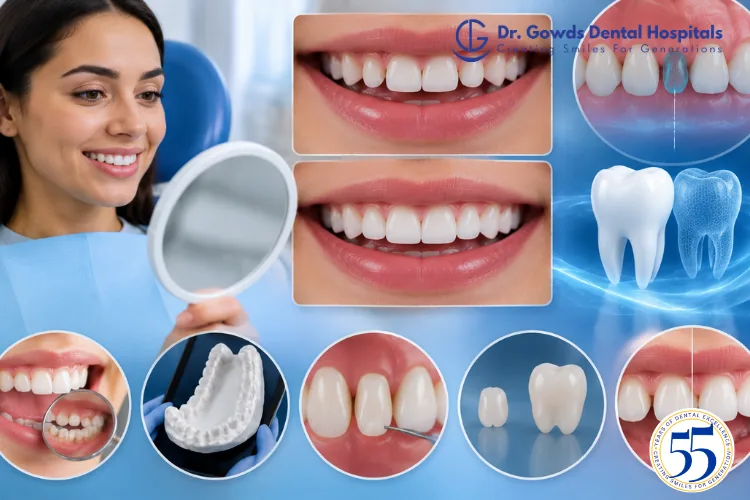
Not every tooth develops to the same size. Differences in tooth shape and dimensions are common, but sometimes a tooth is noticeably smaller than expected for the person’s age, dental arch, or overall tooth proportions. This developmental difference is known as microdontia.
Microdontia is more than simply having naturally small-looking teeth. It describes teeth that are unusually small in relation to what would normally be expected. It may affect one tooth, several teeth, or, less commonly, many teeth.
A particularly recognizable example is a small, tapered upper lateral incisor, sometimes called a peg lateral. However, microdontia can involve other teeth as well.
For some people, the difference is mainly cosmetic. For others, unusually small teeth can create spaces, affect the bite, trap food, or occur alongside other dental development concerns.
At Dr Gowds Dental Hospitals, evaluating the tooth itself, surrounding teeth, bite, and overall smile is important before deciding whether treatment is necessary. The right approach depends on why the tooth is small, which teeth are affected, and whether the concern is functional, developmental, aesthetic, or a combination of these.
Microdontia is a dental developmental condition in which one or more teeth are smaller than the expected normal size.
The reduction may involve:
The tooth may also have an unusual shape.
Microdontia is therefore not defined solely by how a tooth looks from the front. Dental professionals consider the tooth’s dimensions and morphology when evaluating the condition.
Not necessarily.
Some people naturally have relatively small teeth compared with their facial or jaw proportions. This does not automatically mean they have microdontia.
Microdontia refers to a tooth or group of teeth that is abnormally small compared with expected dental dimensions.
The distinction can be important because a naturally small tooth may not require treatment, whereas a markedly undersized or unusually shaped tooth may create spacing or functional concerns.
Microdontia can affect different teeth, but certain patterns are more commonly recognized.
The upper lateral incisors, located next to the central front teeth, are particularly well known for a localized form of microdontia.
When these teeth are unusually small and tapered, they are commonly called peg-shaped lateral incisors or peg laterals.
Wisdom teeth can also show considerable variation in size and shape.
In some individuals, several teeth may be smaller than expected rather than a single tooth being affected.
The pattern of affected teeth can provide useful information during diagnosis.
The appearance depends on the type of microdontia.
A small tooth may have:
For example, a peg lateral incisor may appear narrower than the neighboring front teeth and may have a pointed or tapered crown.
However, visual appearance alone cannot establish a diagnosis.
Microdontia can have several possible associations, and the cause is not always obvious.
Tooth size and shape are strongly influenced by genetics.
A person may inherit a tendency toward particular tooth dimensions or developmental patterns.
This is one reason certain unusual tooth shapes can occur within families.
Teeth develop through a complex process involving different stages of tissue formation.
A disturbance during tooth development can affect the final size or shape of the tooth.
Microdontia can sometimes occur alongside broader genetic or developmental conditions.
When multiple teeth are unusually small, the dentist may consider whether additional dental or medical assessment is appropriate.
Importantly, having one small tooth does not automatically mean that a person has an underlying systemic condition.
Yes.
Microdontia can occur in primary teeth as well as permanent teeth.
If a child’s tooth appears unusually small or differently shaped, a pediatric dental assessment can help determine whether the difference is simply developmental variation or part of a broader dental issue.
Monitoring can be particularly useful because primary teeth play an important role in guiding the eruption and spacing of permanent teeth.
It can.
When a tooth is significantly narrower than expected, the surrounding teeth may not naturally close the available space.
This can result in:
The amount of spacing depends on the size of the affected tooth and the alignment of the surrounding teeth.
Not necessarily.
A small tooth does not automatically require correction.
Treatment may be unnecessary when:
Treatment becomes more relevant when microdontia causes a noticeable aesthetic imbalance, spacing problem, food trapping, bite concern, or difficulty maintaining the surrounding area.
In many cases, yes.
If the tooth is healthy and the main issue is its size or shape, conservative restorative options may allow the visible portion to be modified without extracting the tooth.
The appropriate approach depends on the individual tooth.
Extraction should not be assumed simply because a tooth is unusually small.
Microdontia itself does not necessarily become worse.
However, an unusually small tooth may continue to create an aesthetic or functional concern if the underlying spacing or alignment is not addressed.
Possible concerns include:
If the tooth is healthy and functioning normally, no treatment may still be the appropriate decision.
A very small tooth can sometimes be confused with a missing tooth, particularly in children when dental development is still occurring.
For example, if a permanent lateral incisor does not appear when expected, several possibilities need to be considered.
The tooth could be:
Dental imaging can help distinguish between these situations.
Microdontia is a developmental difference in which one or more teeth are unusually small. It can affect a single tooth or several teeth and may be most noticeable when a small front tooth creates an imbalance in the smile.
The condition does not automatically require treatment.
For some people, the tooth is healthy and causes no functional concerns. Others may develop spacing, bite, food-trapping, or cosmetic issues that make treatment worthwhile.
The most appropriate solution depends on the individual situation. Composite bonding can sometimes increase the apparent size of a small tooth conservatively, while veneers or crowns may be considered in selected cases. Orthodontic treatment can also help manage spacing and tooth position, and some patients benefit from combining orthodontics with restorative treatment.
For children, monitoring dental development can be particularly important because tooth eruption and jaw growth are still changing.
If you notice an unusually small or peg-shaped tooth, a dental examination can help identify whether it is microdontia and whether any treatment is actually necessary.
At Dr Gowds Dental Hospitals, treatment planning can be tailored to the condition of the tooth, surrounding teeth, bite, age, and long-term oral health goals.
Visit us at-
Dr gowds dental hospital Nanakramguda
Dr gowds dental hospital Gachibowli
Dr gowds dental hospital madhapur
Microdontia is a developmental dental condition in which one or more teeth are smaller than expected in size. It may affect the crown, root, or overall tooth dimensions.
Microdontia may be associated with genetic factors, normal developmental variation, disturbances during tooth development, or certain broader developmental conditions.
Upper lateral incisors are commonly associated with localized microdontia, particularly when they have a small, tapered appearance known as peg lateral incisors. Other teeth can also be affected.
Peg lateral teeth are unusually small, tapered upper lateral incisors. They are a recognizable form of localized microdontia.
It can. If a tooth is significantly narrower than expected, the surrounding teeth may not naturally fill the available space, resulting in visible gaps.
Not always. If the tooth is healthy, functional, and aesthetically acceptable, monitoring may be all that is required.
Yes. Composite bonding can sometimes be used to increase the apparent width or length of a small tooth, particularly in the front of the mouth.
Yes. Microdontia can affect both primary and permanent teeth. In children, monitoring may be recommended while dental development continues.
No. Microdontia means the tooth is present but unusually small. A congenitally missing tooth is absent altogether.
 Gachibowli Branch