

Schedule Appointment


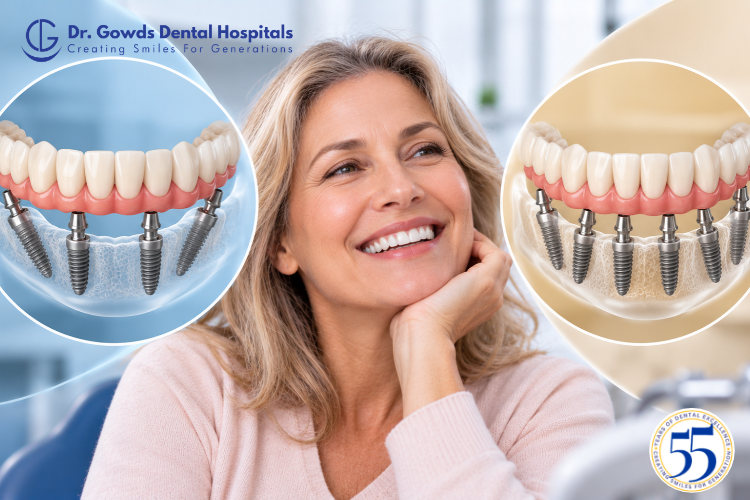
Choosing an implant option for full-mouth restoration can feel confusing, especially when you come across terms such as All-on-4 vs All-on-6 dental implants. Both approaches use dental implants to support a full-arch prosthesis, but they differ in the number and planned positioning of implants.
The important question is not simply whether four or six implants are “better”. The appropriate option depends on factors such as the jaw being treated, available bone, bite, prosthetic requirements, oral condition and the treatment plan created after a dental assessment.
At Dr Gowds Dental Hospitals, patients in Hyderabad can discuss these options with a dental team and understand what each approach may involve before making a decision.
Considering full-mouth dental implants?
All-on-4 refers to a full-arch implant approach that uses four dental implants to support a prosthetic arch. The implants are strategically positioned within the jaw as part of the treatment plan.
Instead of replacing every missing tooth with an individual implant, the approach is designed around an implant-supported foundation for a complete arch of replacement teeth.
The exact implant positions and prosthetic design depend on the individual’s dental anatomy and treatment requirements.
All-on-6 uses six dental implants to support a full-arch prosthesis.
The additional implant positions can change how the restoration is planned and may be considered when the patient’s anatomy and prosthetic requirements make this approach appropriate.
Like All-on-4, All-on-6 is a full-arch concept rather than a treatment designed for just one missing tooth.
The clearest difference is the number of implants, but that is only one part of the decision.
All-on-4: Four implants are used for the planned arch.
All-on-6: Six implants are used for the planned arch.
The number should be viewed in the context of the complete treatment plan rather than as a measure of treatment quality by itself.
Both options require planning around factors such as jaw anatomy, available bone, bite, gum condition and the design of the final prosthesis.
A dentist may use a clinical examination and dental imaging to understand the structures involved and plan the implant positions and restoration.
The final teeth are an important part of the treatment plan. The material, shape, tooth arrangement, bite and design of the prosthesis can all be considered when deciding how the restoration should be planned.
This is why choosing between All-on-4 and All-on-6 should not be based only on the number of implants.
It can be tempting to compare the two options simply by looking at the number of implants. However, the total cost can also depend on diagnostics, implant components, the prosthesis, laboratory work, appointments and follow-up care.
When comparing All-on-4 vs All-on-6 cost, ask for a complete treatment estimate so you understand what is included rather than comparing only the implant count.
There is no universal answer.
All-on-4 may be considered when a treatment plan is designed around four strategically positioned implants. All-on-6 may be considered when six implants are appropriate for the planned restoration.
A larger implant count does not automatically make an option better for every patient. Similarly, choosing four implants does not automatically make an option simpler or more suitable.
The better option is the one that matches the patient’s dental condition, anatomy, prosthetic requirements, expectations and maintenance plan.
The amount and location of available bone are important parts of implant planning. The dentist needs to understand the anatomy of the area where implants are being considered.
This information helps form part of the overall treatment plan rather than relying on the implant count alone.
The upper and lower jaws are not identical. Their shape, available space and relationship with surrounding structures can differ.
For this reason, an implant plan for one arch may not necessarily be identical to the plan for the other arch.
Your bite and the way your teeth come together are relevant when designing a full-arch restoration.
The planned prosthesis needs to be considered alongside the implant positions so that the overall restoration is planned as one system.
Existing teeth, gums, restorations and other oral findings may influence the overall treatment plan.
A dental assessment can help identify these factors before an implant-supported full-arch restoration is planned.
The final restoration is not an afterthought. Its shape, material, tooth arrangement and functional requirements should be considered while selecting the implant approach.
Two patients considering full-mouth dental implants may therefore have different treatment plans.
A full-arch implant restoration still needs regular care. Patients should understand how to clean around the prosthesis and implants and how follow-up appointments will be handled.
Ask your dental team for maintenance instructions specific to your restoration.
Both approaches can be discussed for upper and lower arches, but each arch should be assessed separately.
When people say “full mouth restoration”, they may mean replacing teeth across the entire mouth. In some cases, the treatment plan may involve one arch, while in others, both upper and lower arches may be considered.
The number of implants is therefore not necessarily the same across the entire mouth. The final plan depends on the findings for each arch.
Before starting treatment, ask your dentist:
These questions can make the consultation more useful and help you compare treatment plans based on more than implant count.
Not sure whether All-on-4 or All-on-6 is right for you? Speak with the dental team at Dr Gowds Dental Hospitals to understand the available full-arch restoration options.
The key takeaway is simple: more implants do not automatically mean a better choice, and fewer implants do not automatically mean a better choice.
The appropriate approach should be decided after an individual dental assessment and discussion of the available treatment options.
If you are exploring full-mouth restoration in Hyderabad, a consultation can help you understand the available implant options and how they relate to your dental condition.
Whether you are comparing four versus six implants, exploring full-arch dental implants or simply trying to understand your options, a consultation can help you make an informed decision based on your individual treatment plan.
Looking for full-mouth dental implants in Hyderabad? Visit Dr Gowds Dental Hospitals at Nanakramguda, Gachibowli, Madhapur, koti to discuss All-on-4, All-on-6 and other full-arch restoration options.
The main difference is the number of implants planned to support a full-arch prosthesis. All-on-4 uses four implants per planned arch, while All-on-6 uses six.
Not necessarily. The appropriate option depends on factors such as jaw anatomy, available bone, bite, prosthetic design and the individual’s treatment plan.
They are full-arch implant approaches. “Full-mouth restoration” can refer to treatment involving one or both arches, so the exact treatment plan should be clarified during consultation.
A dentist can assess your oral condition, jaw anatomy, available bone, bite and prosthetic requirements before discussing which approach may be appropriate.
The implant count can affect the treatment cost, but the total price can also depend on the prosthesis, components, diagnostics, laboratory work and follow-up. A complete treatment estimate is more useful than comparing implant prices alone.
Treatment timelines vary because they depend on the treatment plan, clinical findings, appointments and prosthetic stages. Your dental team can provide a timeline specific to your case.
Both approaches can be considered for the upper jaw, but the choice depends on the individual’s anatomy and treatment requirements.
Ask your dental team for instructions specific to your prosthesis and implants. Daily cleaning and scheduled follow-up should be part of the maintenance plan.
 Gachibowli Branch