

Schedule Appointment


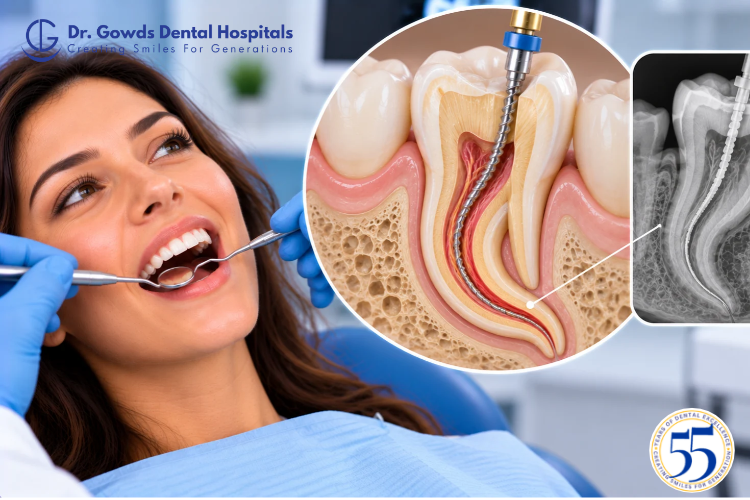
A tooth root is not always straight. Some roots are gently curved, while others may have a more pronounced bend or hook near the end. When a tooth needs root canal treatment, this shape can make the internal canal pathway more complex to follow.
For someone searching for a curved root canals, the key question is simple: what makes a bent or hooked root different? It comes down to the shape of the canal, visibility, access and the need to follow the tooth’s natural anatomy carefully.
This guide explains what curved tooth roots are, why they can make root canal treatment more technically demanding, how dentists assess them and what patients can expect. Dr Gowds Dental Hospitals provides dental consultations across Nanakramguda, Gachibowli, Madhapur, koti in Hyderabad.
Tooth roots extend into the jaw and contain narrow spaces called root canals. These canals form the internal pathway of the tooth.
A root does not have to follow a perfectly straight line. Depending on the tooth, the root may:
These variations mean the shape of the root can influence how easily the internal canal pathway can be accessed and followed during root canal treatment.
A straightforward canal is easier to follow. A curved canal requires the dentist to account for changes in direction while working within a very small space.
A curved root can mean the canal also changes direction. Instruments used during treatment need to follow that pathway rather than assuming it is straight.
The deeper part of a root canal cannot be viewed directly like the visible part of a tooth. The dentist therefore works with information from the tooth’s anatomy and diagnostic images while following the canal pathway.
Some canals become narrower or change shape as they extend towards the end of the root. This can add complexity when the canal also has a pronounced curve.
A tooth can have more than one root canal. When canals branch, curve or follow different paths, identifying and navigating the anatomy requires additional attention.
When root anatomy is unusual, planning is an important part of the process. The dentist may assess the tooth, discuss its symptoms and review appropriate dental images.
The aim is to understand the anatomy before treatment begins. This can help the dentist anticipate areas where the canal pathway changes direction or becomes difficult to follow.
A patient may hear terms such as “curved root”, “complex canal anatomy” or “difficult canal” during a consultation. These terms describe the anatomy and the level of technical attention that may be required.
The treatment approach depends on the individual tooth. A typical process may involve several stages.
The dentist examines the tooth and reviews the relevant dental history and diagnostic information.
An opening is made in the tooth to reach the internal canal space. The access is planned according to the tooth’s anatomy.
Once the canal is located, the dentist works through its natural pathway. With a curved canal, this requires attention to its direction and shape.
The canal is prepared according to its anatomy. In a curved root, the working pathway needs to be followed carefully because it is not straight.
After preparation, the canal is filled and sealed according to the treatment plan. The tooth may then require further restoration depending on its condition.
The exact steps vary between teeth. A front tooth, premolar and molar can have very different internal anatomy.
The main difference is the shape of the pathway the dentist has to follow.
Not every curved root has the same level of complexity. The degree and location of the curve, the number of canals and the overall anatomy all matter.
If you are told that your tooth has a curved or hooked root, it is natural to have questions.
You can ask your dentist:
Understanding the anatomy can make the treatment plan easier to follow and gives you an opportunity to discuss concerns before treatment starts.
If a previous dental examination has identified unusual root anatomy, discuss the findings with the dental team at Dr Gowds Dental Hospitals and understand what the next step may involve.
Root canal treatment takes place inside a small, enclosed part of the tooth. When the anatomy is curved, narrow or otherwise unusual, the treatment needs to account for the individual canal pathway rather than assuming every tooth is the same.
The important point is that a curved root does not tell the whole story. The shape, position and number of canals all form part of the overall picture.
If a dentist has recommended root canal treatment, ask why the treatment has been suggested and what the tooth’s internal anatomy looks like.
You may want to arrange an evaluation if:
Rather than assuming that all root canals are the same, ask about the anatomy of your specific tooth.
Bent, curved or hooked tooth roots are one reason root canal anatomy can vary from one tooth to another. When the canal changes direction, the dentist has to work with that anatomy rather than treating the canal as a straight pathway.
Understanding the root shape, assessing the canal anatomy and planning the treatment accordingly are important parts of managing a more complex root canal case.
If you have been told that your tooth has a curved root, the next step is to understand the anatomy of your tooth and discuss the treatment approach with a dentist.
A curved root can be considered as part of root canal planning. The approach depends on the tooth’s anatomy and the canal pathway.
A curved canal changes direction, so the dentist has to follow its natural pathway within a small space rather than a straight route.
A hooked tooth root is a root with a more pronounced bend, often towards the end of the root. Its shape can be assessed through dental examination and imaging.
Yes. Molar roots can have different shapes and may follow different paths. The internal anatomy is assessed before treatment is planned.
Not necessarily. The level of complexity depends on factors such as the degree and location of the curve, the number of canals and the overall anatomy.
Ask which root is curved, how many canals are present, what imaging is needed and how the root shape affects the proposed treatment plan.
 Gachibowli Branch