

Schedule Appointment


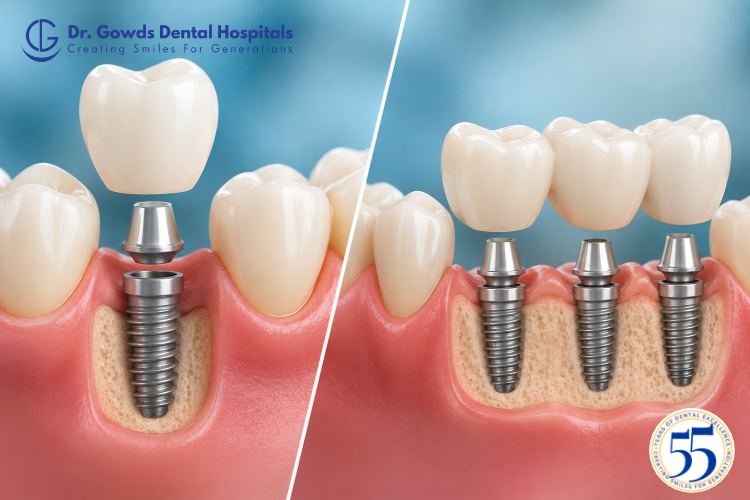
Losing one tooth and losing several teeth are different situations, so the dental implant approach may also be different. If you are comparing a single tooth implant vs multiple teeth implants, understanding the basic differences can help you have a more informed conversation with your dentist.
A single missing tooth may be considered for an individual implant restoration, while several missing teeth may involve multiple implants or an implant-supported restoration, depending on the location of the missing teeth and your overall dental assessment.
At Dr Gowds Dental Hospitals, patients can discuss their tooth replacement options with a dental professional and understand which approach may suit their individual situation.
Considering dental implants in Hyderabad?
A single tooth implant is a treatment option designed for a person who has one missing tooth.
The restoration generally involves three main components:
The exact treatment plan depends on factors such as the location of the missing tooth, surrounding teeth, available space, oral health and the dentist’s assessment.
A single tooth implant may be discussed when:
The important point is that replacing one missing tooth does not automatically mean that the same treatment plan will work for another person with a similar-looking gap.
Multiple teeth implants refer to implant-based treatment when more than one tooth is missing.
The approach can vary considerably depending on whether the missing teeth are next to each other or located in different areas of the mouth.
For example, a person with several missing teeth in one area may have different treatment considerations from someone who has individual missing teeth in separate areas.
Possible treatment planning may involve:
The number of implants required is not determined simply by counting the number of missing teeth. The dentist considers the overall situation before recommending a treatment approach.
Understanding the difference between the two can make your consultation easier.
A single tooth implant generally addresses one missing tooth.
Multiple teeth implant treatment is considered when several teeth are missing and requires a broader treatment plan.
Single tooth replacement may involve planning around one specific space.
Multiple teeth replacement requires consideration of the position of several missing teeth, the relationship between them and the surrounding teeth.
A single missing tooth may be restored with an individual crown supported by an implant.
For multiple missing teeth, the restoration may involve individual implant-supported crowns or an implant-supported bridge, depending on the treatment plan.
The number of missing teeth does not necessarily equal the number of implants required.
For multiple missing teeth, the dentist determines the appropriate implant and restoration arrangement based on the individual case.
Replacing one tooth can involve a more focused treatment plan.
Replacing multiple teeth may require more detailed planning because several areas of the mouth may need to be considered together.
This is one of the most common questions people ask when researching dental implants.
The answer depends on the individual treatment plan.
For a single missing tooth, one implant may be considered for that particular replacement. When several teeth are missing, the dentist may discuss different implant-supported restoration options rather than automatically placing one implant for every missing tooth.
Factors that may be considered include:
This is why an in-person dental evaluation is important before deciding how many implants you may need.
When several missing teeth are located next to each other, the treatment plan may differ from replacing individual teeth in separate parts of the mouth.
An implant-supported bridge may be one of the options discussed during consultation.
Instead of treating every missing tooth as a completely separate case, the dentist evaluates the entire area and plans the restoration accordingly.
The suitability of an implant-supported bridge depends on the patient’s individual dental condition and the planned restoration.
When missing teeth are located in different parts of the mouth, each area may need to be assessed separately.
For example, a person may have one missing tooth on one side and another missing tooth elsewhere. In such situations, the treatment plan may involve different considerations for each location.
Your dentist may assess:
The final plan should therefore be based on your complete dental assessment rather than a general rule.
People looking for a single tooth implant may also come across dental bridges.
A traditional bridge and an implant-supported restoration are different approaches to replacing a missing tooth or teeth.
A traditional dental bridge uses neighbouring teeth as part of the restoration. An implant-based option uses dental implant support.
Which option is appropriate depends on your dental condition, the surrounding teeth and the treatment plan recommended by your dentist.
If you are unsure which option is suitable, discussing both choices during a consultation can help you understand the differences before making a decision.
Choosing between single and multiple teeth implants should not be based only on the number of missing teeth.
A dental consultation may consider several aspects of your oral condition.
The position of the missing tooth or teeth can influence the restoration being considered.
Neighbouring teeth and the surrounding oral structures are part of the overall treatment assessment.
The dentist may evaluate the condition of the gums and jawbone before discussing implant treatment.
The way the upper and lower teeth meet, along with available space, can be relevant when planning a restoration.
Your preferred restoration, dental needs and long-term oral care routine can all be discussed when developing a treatment plan.
Online information can help you understand the difference between single tooth vs multiple teeth implants, but it cannot determine which option is right for your mouth.
Two people with the same number of missing teeth may have completely different treatment considerations.
During a consultation, your dentist can assess the missing teeth, surrounding structures and available treatment options. This allows the discussion to move from general information to a plan based on your individual dental condition.
If you have one or more missing teeth, you can consult Dr Gowds Dental Hospitals in Hyderabad to understand the available implant and tooth replacement options.
You can make your dental consultation more useful by being prepared to discuss:
You can also ask your dentist:
There is no single answer that applies to everyone.
If you have one missing tooth, your dentist may discuss an individual implant-supported restoration. If you have several missing teeth, the discussion may include multiple implants, individual restorations or an implant-supported bridge.
The right choice depends on the location and number of missing teeth, surrounding teeth, available space, oral condition and the restoration being planned.
Rather than choosing an option based only on online information, use your consultation to understand the available choices and how they relate to your specific dental needs.
For dental implant consultation in Hyderabad, speak with Dr Gowds Dental Hospitals at Nanakramguda, Gachibowli, Madhapur, koti.
A single tooth implant is generally planned for one missing tooth, while multiple teeth implant treatment involves planning for several missing teeth. The restoration and number of implants can vary according to the individual case.
Not necessarily. The number of implants depends on factors such as the location of the missing teeth, available space, surrounding teeth and the type of restoration being planned.
Dental implants can be considered when multiple teeth are missing. Depending on the situation, the treatment plan may involve individual implant restorations or an implant-supported bridge.
Neither option should be considered universally better. A dentist can compare the options based on the missing tooth, surrounding teeth, oral condition and the type of restoration being considered.
A dental examination is needed to determine the appropriate treatment approach. Your dentist can evaluate the missing teeth, surrounding structures and available restoration options.
It may be possible to plan implant-based replacement for teeth missing in different areas, but each area may require individual assessment. The final treatment plan depends on your dental condition.
You can ask about the number of implants being considered, restoration options, required assessments, treatment stages, maintenance and the alternatives available for your particular situation.
 Gachibowli Branch