

Schedule Appointment

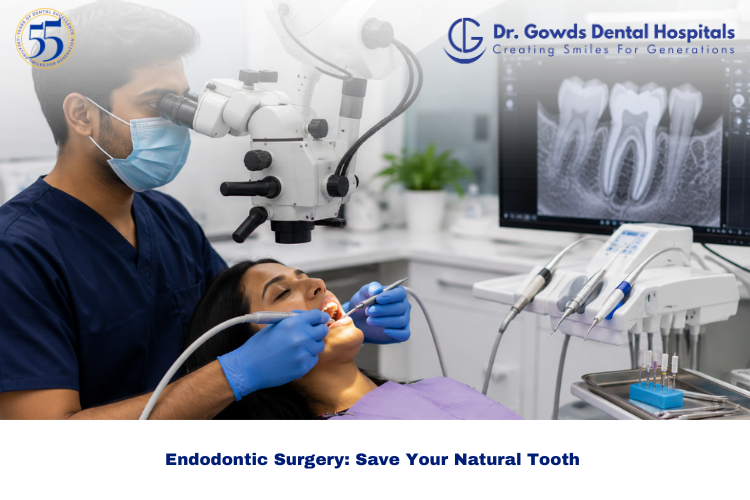
If a tooth remains infected after a root canal treatment, endodontic surgery may be recommended to save the tooth. Endodontic surgery is a specialized dental procedure that treats infection or inflammation around the root tip when conventional root canal therapy alone is not enough.
Modern endodontic microsurgery is highly precise, minimally invasive, and often allows patients to preserve natural teeth that might otherwise require extraction.
At Dr. Gowds Dental Hospital, Hyderabad, our endodontic specialists use advanced imaging and microscopic techniques to diagnose and manage complex root-related infections while prioritizing long-term tooth preservation.
Endodontic surgery refers to procedures performed on the root and surrounding tissues of a tooth to eliminate infection, promote healing, and preserve the natural tooth.
While most root canal problems can be treated through conventional root canal therapy, some cases require a surgical approach to access areas that cannot be reached through the crown of the tooth.
The most common type of endodontic surgery is an apicoectomy, also known as root-end surgery.
During the procedure, the infected tissue surrounding the root tip is removed, the root end is cleaned, and a small filling is placed to seal the canal.
Your dentist or endodontist may recommend endodontic surgery when:
The goal is to remove infection while preserving the natural tooth whenever possible.
Common symptoms include:
Pain that continues months after a root canal may indicate unresolved infection.
Swelling near a previously treated tooth can be a sign of infection around the root tip.
Repeated pus formation or gum boils often suggest chronic infection.
Pressure-related discomfort may indicate inflammation around the root.
Sometimes patients have no symptoms, but X-rays reveal persistent lesions that require treatment.
This is the most common endodontic surgical procedure.
The endodontist:
This procedure helps eliminate infection and prevents recurrence.
After removing the root tip, a filling material is placed to seal the canal and prevent bacterial leakage.
Occasionally, surgery is performed to identify hidden cracks, fractures, or unusual anatomical structures that cannot be detected through routine examinations.
Endodontic surgery may be used to repair:
These procedures can help preserve teeth that might otherwise require extraction.
Advanced digital X-rays or CBCT scans are used to assess:
The area is thoroughly numbed to ensure patient comfort.
A small incision is made in the gum near the affected tooth.
The infected tissue around the root tip is carefully removed.
The root tip is cleaned and sealed.
The gum tissue is repositioned and secured with sutures.
Most procedures are completed within 30–90 minutes depending on complexity.
Most patients are surprised by how comfortable the procedure is.
During surgery:
After surgery:
These symptoms typically improve within a few days and can usually be managed with prescribed medications.
Most patients resume normal activities within 24–48 hours.
You may experience:
Sutures are generally removed within a week if non-resorbable sutures are used.
Many patients wonder whether extraction is a better option.
| Endodontic Surgery | Tooth Extraction |
| Preserves natural tooth | Removes tooth permanently |
| Maintains natural bite | May require replacement |
| Preserves surrounding bone | Bone loss may occur over time |
| Often less extensive than replacement options | Additional restorative procedures may be needed |
Whenever possible, preserving the natural tooth is generally the preferred option.
Preserving natural teeth remains the gold standard in dentistry.
The procedure targets infection that cannot be reached through conventional treatment.
Many teeth can be saved despite previous treatment failure.
Pain, swelling, and recurrent infections can often be resolved.
Treating chronic infection protects surrounding bone and tissues.
Endodontic surgery is a highly effective solution for treating persistent root infections and saving teeth that might otherwise be lost. Procedures such as apicoectomy and root-end surgery allow dentists to address problems beyond the reach of conventional root canal treatment.
If you have ongoing symptoms after a root canal or have been advised that a tooth requires surgical treatment, an evaluation by an endodontic specialist can help determine the best course of action.
With modern techniques and expert care, endodontic surgery offers a predictable way to preserve your natural smile and maintain long-term oral health.
Visit us at-
Dr gowds dental hospital Nanakramguda
Dr gowds dental hospital Gachibowli
Dr gowds dental hospital madhapur
An apicoectomy, also called root-end surgery, is the most commonly performed endodontic surgical procedure.
No. A root canal treats infection from inside the tooth, while endodontic surgery treats infection around the root tip and surrounding tissues.
Most procedures take between 30 and 90 minutes, depending on the complexity of the case.
Most patients recover within a few days and can return to normal activities within 24–48 hours.
Yes. Endodontic surgery is often recommended when a previous root canal has not healed properly and infection persists.

 Gachibowli Branch