

Schedule Appointment

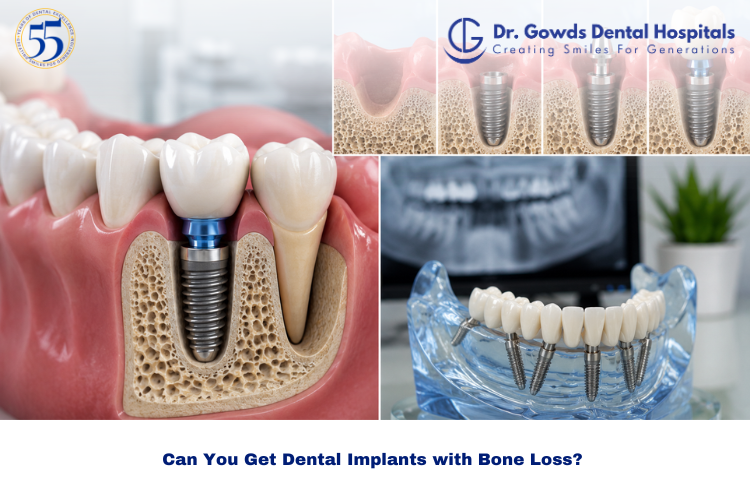
Yes, in most cases, you can still get dental implants even if you have experienced bone loss. Modern dentistry offers several advanced solutions—including bone grafting, sinus lifts, and specialized implant techniques—that can help rebuild or work around insufficient bone, making dental implants possible for many patients who were previously considered unsuitable candidates.
Medically Reviewed by: Prof. Dr. Snigdha Gowd, MDS (Orthodontics & Dentofacial Orthopaedics)
If you’ve been told you don’t have enough bone for implants, don’t assume you’ve run out of options. A detailed evaluation by an experienced implant dentist can often identify a suitable treatment pathway.
Dental implants function as artificial tooth roots. They are placed into the jawbone and rely on a process called osseointegration, where the bone grows around the implant and secures it firmly in place.
For successful implant treatment, the jawbone must provide:
When significant bone loss occurs, there may not be enough healthy bone to support a standard dental implant without additional treatment.
Jawbone loss is more common than many people realize. Several conditions can gradually reduce bone volume over time.
When a tooth is lost, the jawbone beneath it no longer receives stimulation from chewing. As a result, the bone begins to shrink.
Studies show that significant bone resorption can occur during the first year after tooth loss.
Advanced periodontal disease destroys the tissues and bone supporting teeth. Severe gum disease is one of the leading causes of implant-related bone deficiencies.
Accidents, sports injuries, and facial trauma can result in bone damage or loss.
Traditional dentures rest on the gums rather than stimulating the jawbone. Over time, this can accelerate bone resorption.
Untreated dental infections, cysts, or tumors can damage the surrounding bone structure.
Certain systemic conditions, osteoporosis, and age-related changes can contribute to reduced bone density.
A clinical examination alone cannot accurately assess bone volume.
Your implant dentist will typically use:
These tools help evaluate:
At Dr. Gowds Dental Hospital, advanced 3D imaging is used to assess bone availability and create personalized implant treatment plans before surgery.
In many cases, yes.
The treatment approach depends on:
Patients with mild, moderate, and even severe bone loss may still qualify for implant treatment through specialized procedures.
Bone grafting is the most common solution for patients with inadequate jawbone.
The procedure involves adding bone material to the deficient area, allowing new bone to develop over time.
Bone graft materials may include:
After healing, the newly formed bone can provide sufficient support for implants.
When bone loss occurs in the upper back jaw, the sinus cavity often limits implant placement.
A sinus lift procedure:
This increases bone height and allows future implant placement.
Sinus augmentation is commonly performed before implant treatment in the upper molar region.
If the jaw ridge becomes too narrow after tooth loss, ridge augmentation may be recommended.
This procedure rebuilds the width of the jawbone, creating enough space for implant placement.
In select cases, short implants can be used when vertical bone height is limited.
Advantages include:
However, suitability depends on individual bone quality and bite forces.
For patients with severe upper jaw bone loss, zygomatic implants may be an option.
Instead of anchoring into the upper jawbone, these longer implants are secured in the cheekbone (zygoma), which typically maintains its density even when the jawbone has deteriorated.
This approach may eliminate the need for extensive bone grafting.
Some patients with moderate bone loss may qualify for All-on-4® dental implants.
This technique uses strategically angled implants to maximize available bone and support a full arch of replacement teeth.
Benefits include:
Severe bone loss does not automatically rule out dental implants.
Many patients successfully receive implants after:
The key is choosing an implant team experienced in managing complex bone-deficient cases.
Sometimes.
Healing times vary depending on:
Typical healing periods range from a few months to several months before implants are placed.
In some situations, bone grafting and implant placement can be performed during the same appointment.
Your implant specialist will determine the most appropriate timeline.
Ignoring jawbone loss can lead to:
Early intervention often provides more treatment options and better outcomes.
Modern implant dentistry has made treatment highly predictable.
When properly planned and executed:
Success depends on factors such as:
Being told you have insufficient bone for dental implants can feel discouraging, but it rarely means implants are impossible. Advances in implant dentistry have created multiple solutions for patients with mild, moderate, and even severe bone loss.
Whether through bone grafting, sinus augmentation, All-on-4 treatment, or specialized implant techniques, many patients who were once considered unsuitable candidates can now enjoy the benefits of fixed, natural-looking replacement teeth.
The first step is a thorough evaluation by an experienced implant team that can assess your bone levels and recommend the most appropriate treatment plan for your specific needs.
Dr gowds dental hospital Nanakramguda
Dr gowds dental hospital Gachibowli
Dr gowds dental hospital madhapur
Yes. Many patients with bone loss can still receive implants through bone grafting, sinus lifts, or specialized implant techniques.
The exact requirement varies depending on the implant size and location. A CBCT scan is typically used to determine bone availability.
No. Some patients qualify for short implants, All-on-4 implants, or zygomatic implants without extensive grafting.
Healing can range from a few months to several months depending on the graft size and individual healing response.
Yes. When properly planned and maintained, implants placed after successful bone grafting have excellent long-term success rates.
 Gachibowli Branch