

Schedule Appointment


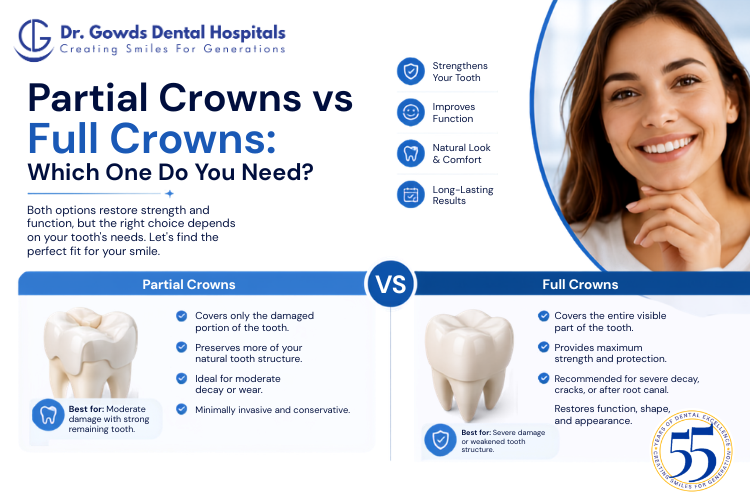
Choosing between full-coverage crowns and partial crowns depends on how much of your natural tooth remains, the extent of damage or decay, the location of the tooth, and the amount of chewing force it must withstand. A partial crown restores only the damaged portion of a tooth, preserving more healthy enamel, while a full-coverage crown completely covers the visible portion of the tooth to provide maximum strength and protection. Your dentist will recommend the most suitable option after evaluating your tooth, bite, and long-term restorative needs.
At Dr. Gowds Dental Hospitals, we believe in preserving as much natural tooth structure as possible while providing durable, aesthetically pleasing restorations that restore both function and confidence.
A partial crown is a custom-made restoration that repairs only the damaged portion of a tooth instead of covering the entire tooth.
Partial crowns are commonly referred to as:
Unlike traditional fillings, they are fabricated outside the mouth and bonded precisely to the prepared tooth.
The goal is to restore strength while preserving healthy natural enamel.
A full-coverage crown is a cap that completely covers the visible portion of a damaged tooth.
It restores:
Full crowns are recommended when a tooth has lost significant structure and requires complete protection against fracture.
Modern crowns may be fabricated from:
The material depends on the tooth’s location and your treatment goals.
Many patients assume that every damaged tooth requires a crown.
However, modern restorative dentistry focuses on preserving natural tooth structure whenever possible.
If enough healthy enamel remains, a partial crown can often provide excellent strength while avoiding unnecessary removal of healthy tissue.
This conservative approach supports better long-term tooth health.
| Feature | Partial Crowns | Full-Coverage Crowns |
| Covers entire tooth | No | Yes |
| Preserves natural tooth | More | Less |
| Tooth preparation | Conservative | More extensive |
| Best for moderate damage | Yes | No |
| Best for severe damage | Limited | Yes |
| Strength | High | Very high |
| Appearance | Excellent | Excellent |
| Longevity | Excellent | Excellent |
Both restorations are durable, but they serve different clinical purposes.
Your dentist may recommend a partial crown if:
Because partial crowns preserve more natural tooth structure, they are often preferred whenever clinically appropriate.
A full-coverage crown may be necessary if:
In these situations, full coverage offers better long-term protection.
Every tooth is different.
Your dentist carefully evaluates several factors before recommending a restoration.
The more healthy tooth that remains, the greater the possibility of using a partial crown.
When very little healthy structure remains, a full crown is often safer.
Back teeth experience much higher chewing forces than front teeth.
Molars often require stronger restorations because they absorb the greatest pressure during chewing.
Small-to-moderate defects may be restored with partial crowns.
Extensive damage usually requires complete coverage.
Cracked or weakened teeth sometimes require full crowns to reduce the risk of future fracture.
Teeth with multiple large fillings or repeated repairs often benefit from full-coverage crowns for added reinforcement.
Patients who grind or clench their teeth place greater stress on restorations.
Your dentist considers these forces when selecting the appropriate treatment.
Both partial crowns and full-coverage crowns can be fabricated using highly aesthetic ceramic materials that closely resemble natural teeth.
Whether receiving a partial crown or a full crown, the treatment process is similar.
Your dentist performs:
The damaged portion is carefully removed.
The amount of tooth reduction depends on the chosen restoration.
Partial crowns require less preparation than full crowns.
A digital intraoral scan or conventional impression records the prepared tooth.
The restoration is designed using advanced CAD/CAM technology or fabricated in a dental laboratory.
Your dentist checks:
The restoration is permanently cemented, and your bite is adjusted for optimal function.
A partial crown offers several advantages.
Only the damaged area is restored.
Less healthy enamel is removed.
Modern ceramic partial crowns provide excellent strength.
They blend seamlessly with surrounding teeth.
Preserving healthy tooth structure supports long-term durability.
A full-coverage crown provides:
It remains the preferred treatment for teeth with extensive damage.
Both restorations can last many years with proper care.
Their longevity depends on:
Many ceramic restorations function successfully for 10–15 years or longer.
Protect your restoration by:
Good oral hygiene protects both the restoration and the supporting tooth.
Yes.
If additional damage occurs over time, a partial crown can sometimes be replaced with a full-coverage crown if clinically necessary.
Choosing a conservative restoration initially does not prevent future treatment options.
When deciding between full-coverage crowns and partial crowns, there is no one-size-fits-all solution. The best choice depends on the amount of healthy tooth remaining, the location of the tooth, the extent of damage, and your long-term oral health needs.
Whenever possible, dentists aim to preserve natural tooth structure with a partial crown, while full-coverage crowns remain the ideal option for severely weakened teeth that require maximum protection. A comprehensive dental evaluation ensures you receive the most appropriate treatment for lasting function and aesthetics.
If you have a damaged tooth and are unsure which restoration is right for you, consult the restorative dentistry team at Dr. Gowds Dental Hospitals. We use advanced diagnostic technology and personalized treatment planning to help restore your smile with confidence.
Visit us at-
Dr gowds dental hospital Nanakramguda
Dr gowds dental hospital Gachibowli
Dr gowds dental hospital madhapur
A partial crown restores only the damaged portion of the tooth, while a full-coverage crown covers the entire visible part of the tooth for maximum protection.
Yes. Because a partial crown is custom-made and bonded to the tooth, it generally provides greater strength and durability than a large filling.
A full-coverage crown is usually recommended when a tooth has extensive decay, significant fractures, has undergone root canal treatment, or has insufficient healthy tooth structure remaining.
With proper oral hygiene and regular dental check-ups, both restorations can last 10–15 years or longer, depending on the material used and your oral habits.
A partial crown preserves more healthy enamel because it restores only the damaged area, making it the preferred option whenever the remaining tooth structure is strong enough to support it.
 Gachibowli Branch