

Schedule Appointment

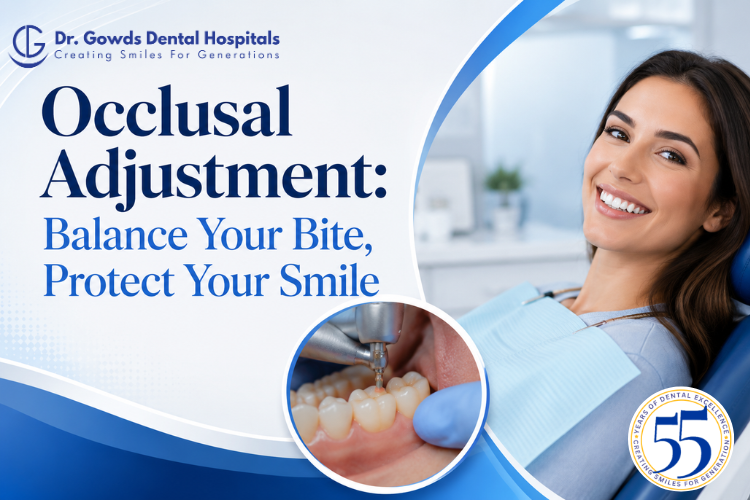
Occlusal Adjustment is a dental procedure that carefully reshapes tiny areas of the biting surfaces of the teeth to improve how the upper and lower teeth come together. Also known as bite adjustment or bite equilibration, this treatment helps distribute biting forces more evenly, reducing excessive pressure on certain teeth, gums, and jaw joints. Occlusal adjustment is commonly recommended for patients with uneven bites, tooth wear, discomfort while chewing, teeth grinding, or as part of periodontal treatment to protect teeth with reduced bone support.
At Dr. Gowds Dental Hospitals, our dentists use detailed bite analysis and modern diagnostic techniques to determine whether occlusal adjustment is appropriate as part of a comprehensive treatment plan.
Occlusal Adjustment is a conservative dental procedure that improves the way your teeth fit together when you bite or chew.
During the procedure, the dentist makes very small, precise adjustments to the enamel on selected teeth to eliminate areas where excessive biting pressure occurs.
The goal is not to remove large amounts of tooth structure but to create a more balanced bite that allows the teeth and jaw to function comfortably.
Your teeth are designed to work together evenly.
When the bite is balanced:
If one or more teeth contact earlier or more heavily than others, excessive pressure may develop, potentially affecting both the teeth and surrounding structures.
Several conditions can lead to the need for Occlusal Adjustment.
Common causes include:
Your dentist will identify the underlying cause before recommending treatment.
Many people are surprised to learn that bite problems can influence gum health.
Although bacteria remain the primary cause of gum disease, excessive biting forces may place additional stress on teeth that already have weakened periodontal support.
In patients with periodontal disease, an uneven bite may contribute to:
For this reason, Occlusal Adjustment is sometimes included as part of comprehensive periodontal care when excessive biting forces are identified.
Your dentist may recommend Occlusal Adjustment if you experience:
These symptoms do not always require bite adjustment, but they should be professionally evaluated.
Your dentist may suggest Occlusal Adjustment in several situations.
Sometimes a filling or crown may feel slightly high after treatment.
Minor adjustments help restore comfortable biting.
Patients with advanced gum disease may benefit from bite adjustment if excessive forces are contributing to tooth mobility.
Bruxism can create uneven wear patterns and heavy bite contacts.
Occlusal adjustment may be recommended in selected cases alongside other treatments, such as a night guard.
Occasionally, minor bite refinements may improve overall function after braces or clear aligner treatment.
Injuries that alter the bite may require careful correction once healing has occurred.
The procedure is carefully planned and highly conservative.
Your dentist examines:
Special articulating paper is often used to identify high contact points.
In some cases, digital bite analysis or additional imaging may be used to evaluate how your teeth function during chewing.
Using fine dental instruments, the dentist removes microscopic amounts of enamel from carefully selected areas.
Only minimal adjustments are made to improve bite balance.
After each adjustment, your bite is checked again to ensure that pressure is distributed evenly.
Several small refinements may be made during the appointment.
Your dentist confirms that:
No.
Most patients experience little or no discomfort because only tiny amounts of enamel are adjusted.
In many cases:
If larger adjustments are needed, your dentist will discuss the most appropriate approach.
No.
This is an important misconception.
Occlusal Adjustment does not treat the bacterial infection that causes gum disease.
Professional periodontal treatment—including scaling and root planing, good oral hygiene, and regular maintenance—is essential for managing gum disease.
Occlusal adjustment may be recommended as an additional procedure when bite-related forces are affecting teeth with compromised periodontal support.
Occlusal Adjustment is a conservative procedure that helps create a more balanced bite by eliminating excessive pressure on selected teeth. While it is not a treatment for gum disease itself, it can play an important role in protecting teeth affected by periodontal problems, improving chewing comfort, and reducing unnecessary stress on the teeth, gums, and jaw joints.
Not everyone with an uneven bite requires occlusal adjustment, which is why a careful clinical evaluation is essential. When combined with good oral hygiene, regular dental check-ups, and appropriate periodontal or restorative treatment, bite adjustment can contribute to better long-term oral health and function.
If you experience discomfort while biting, uneven tooth wear, or persistent jaw pain, consult the experienced dental team at Dr. Gowds Dental Hospitals. We will assess your bite and recommend the most suitable treatment to help restore comfort, stability, and lasting oral health.
Visit us at-
Dr gowds dental hospital Nanakramguda
Dr gowds dental hospital Gachibowli
Dr gowds dental hospital madhapur
Occlusal Adjustment is a procedure that carefully reshapes small areas of the teeth to improve bite balance and reduce excessive pressure during chewing.
Yes. Bite equilibration and occlusal adjustment refer to the same procedure, which aims to create even and comfortable tooth contacts.
No. Gum disease is caused primarily by bacterial plaque. Occlusal adjustment may be recommended alongside periodontal treatment when excessive bite forces are affecting teeth with reduced gum and bone support.
In many cases, the adjustments are long-lasting. However, future dental work, tooth movement, or continued teeth grinding may alter the bite over time.
Yes. When performed by an experienced dentist, Occlusal Adjustment is a safe and conservative procedure that removes only minimal amounts of enamel to improve bite function and comfort.
 Gachibowli Branch