

Schedule Appointment


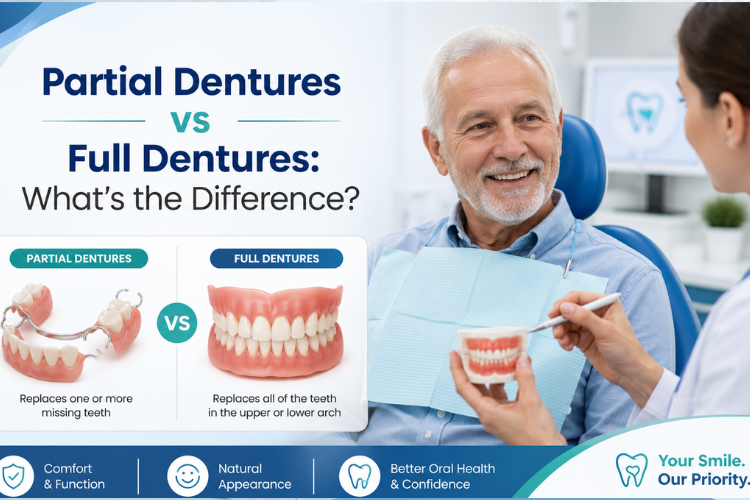
The difference between partial dentures vs full dentures depends on how many natural teeth remain. Partial dentures replace one or more missing teeth while preserving healthy existing teeth, whereas full dentures replace an entire upper or lower arch when all teeth are missing or need to be removed. Choosing the right option depends on your oral health, jawbone condition, remaining teeth, and long-term treatment goals.
At Dr. Gowds Dental Hospitals, every denture treatment begins with a comprehensive oral examination and digital diagnostics to determine whether partial dentures or full dentures are the best solution for restoring your smile, chewing ability, and confidence.
Losing teeth affects much more than your appearance. Missing teeth can make chewing difficult, alter speech, change facial structure, and even lead to additional tooth loss over time.
Fortunately, modern dentures offer reliable and affordable solutions for replacing missing teeth.
Many patients, however, are unsure whether they need partial dentures or full dentures. While both restore oral function and improve aesthetics, they are designed for different situations.
Understanding partial dentures vs full dentures helps you make an informed decision about the most suitable treatment for your oral health and lifestyle.
Partial dentures are removable appliances that replace one or several missing teeth while preserving your remaining healthy natural teeth.
They consist of artificial teeth attached to a gum-colored base, which is supported by nearby natural teeth using precision attachments or clasps.
Partial dentures restore gaps without replacing healthy teeth unnecessarily.
They are commonly recommended for patients who still have strong natural teeth that can support the denture.
Full dentures, also known as complete dentures, replace an entire arch of missing teeth.
They are used when:
Unlike partial dentures, full dentures rest directly on the gums and underlying jawbone to provide support.
Modern full dentures are designed to restore natural facial appearance, improve speech, and help patients eat more comfortably.
| Feature | Partial Dentures | Full Dentures |
| Teeth Replaced | One or several missing teeth | Entire upper or lower arch |
| Remaining Teeth | Natural teeth remain | No natural teeth remain |
| Support | Natural teeth and gums | Gums and jawbone |
| Stability | Generally more stable | Depends on denture fit and bone support |
| Purpose | Replace missing teeth while preserving healthy teeth | Restore complete arches |
| Suitable For | Patients with some healthy teeth | Patients missing all teeth |
The biggest distinction in partial dentures vs full dentures is that partial dentures work alongside your remaining natural teeth, while full dentures replace every tooth in an arch.
Partial dentures are recommended when healthy natural teeth are still present.
Your dentist may suggest partial dentures if you:
Replacing missing teeth early also helps maintain proper bite alignment and reduces excessive stress on surrounding teeth.
Full dentures are recommended when all teeth in an arch are missing or cannot be saved due to extensive damage.
Patients may require full dentures because of:
Complete dentures restore the ability to chew, speak, and smile with confidence.
Partial dentures offer several advantages for patients with remaining healthy teeth.
Unlike full dentures, partial dentures allow healthy teeth to remain functional.
This helps maintain natural chewing efficiency and jaw support.
Because they attach to existing teeth, partial dentures generally feel more secure during eating and speaking.
When teeth are missing, nearby teeth tend to drift into empty spaces.
Partial dentures help maintain proper tooth alignment.
Partial dentures are often less expensive than multiple implants or fixed bridges.
Full dentures restore complete oral function for patients with total tooth loss.
Modern dentures closely resemble natural teeth and improve facial aesthetics.
Missing teeth can cause the cheeks and lips to appear sunken.
Full dentures restore facial support and help maintain a more youthful appearance.
Replacing missing teeth often improves pronunciation and speech clarity.
Although dentures do not function exactly like natural teeth, they greatly improve eating ability compared to having no teeth.
Comfort depends on several factors, including:
In general, partial dentures often feel more stable because natural teeth provide additional support.
Full dentures may require a slightly longer adjustment period, particularly lower dentures, which naturally have less retention.
Proper denture fabrication and follow-up adjustments greatly improve comfort.
Yes.
Some patients initially wear partial dentures but later transition to full dentures if additional teeth are lost over time.
Regular dental examinations allow your dentist to monitor changes and recommend the most appropriate treatment as your oral health evolves.
Some patients may benefit from implant-supported dentures instead of conventional removable dentures.
Dental implants anchor the denture securely to the jawbone, providing:
Not every patient is a candidate for implant-supported dentures, so a detailed clinical evaluation is necessary.
Understanding partial dentures vs full dentures is the first step toward choosing the right tooth replacement solution. Partial dentures are ideal for patients who still have healthy natural teeth, while full dentures provide complete smile restoration when all teeth in an arch are missing.
The right treatment depends on your oral health, remaining teeth, jawbone condition, and personal goals. A professional evaluation ensures you receive the most suitable option for long-term comfort, function, and aesthetics.
If you’re unsure whether partial dentures or full dentures are right for you, the experienced team at Dr. Gowds Dental Hospitals can provide a personalized assessment and recommend the best solution to restore your smile and quality of life.
Visit us at-
Dr gowds dental hospital Nanakramguda
Dr gowds dental hospital Gachibowli
Dr gowds dental hospital madhapur
The main difference between partial dentures vs full dentures is that partial dentures replace a few missing teeth while preserving natural teeth, whereas full dentures replace all teeth in an upper or lower arch.
Neither is universally better. The ideal option depends on how many healthy natural teeth remain and your overall oral health.
Yes. If additional teeth are lost over time, your dentist may recommend replacing partial dentures with full dentures.
Full dentures may require a longer adjustment period than partial dentures, but proper fitting and regular adjustments significantly improve comfort.
With proper care and regular dental checkups, both partial and full dentures can last several years. They may eventually require relining, repairs, or replacement as your gums and jawbone naturally change over time.
 Gachibowli Branch