

Schedule Appointment


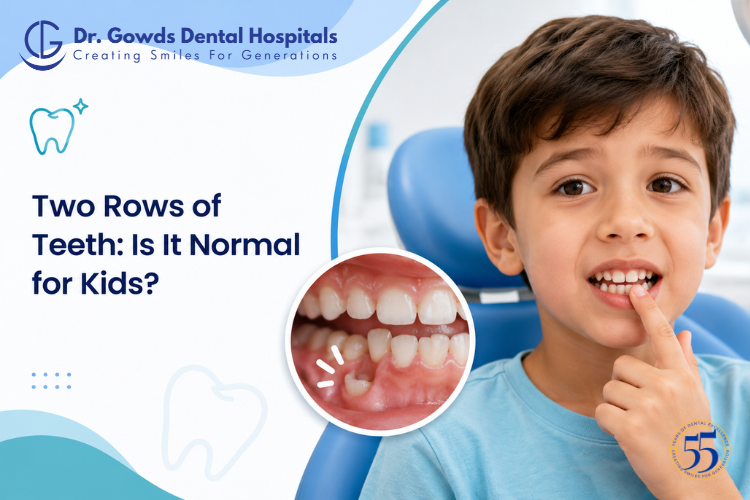
Seeing two rows of teeth in your child’s mouth can be alarming, but in many cases, it’s a normal stage of dental development. Often called “shark teeth,” this happens when a permanent tooth erupts behind a baby tooth that hasn’t fallen out yet. While some cases resolve naturally, others require a dental evaluation to prevent alignment problems. Early assessment helps ensure permanent teeth erupt into the correct position.
At Dr. Gowds Dental Hospitals, our pediatric dentists and orthodontic specialists evaluate children with two rows of teeth using advanced digital imaging and personalized treatment plans to support healthy dental development.
Many parents are surprised to discover a second row of teeth growing behind their child’s baby teeth. Although it may look unusual, this condition is relatively common during the mixed dentition stage, when baby teeth and permanent teeth are present together.
Normally, permanent teeth grow beneath the baby teeth. As they develop, they dissolve the roots of the baby teeth, causing them to loosen and eventually fall out. Sometimes this process is delayed, allowing the permanent tooth to erupt before the baby tooth is lost, creating two rows of teeth.
This temporary appearance is commonly referred to as “shark teeth.”
“Shark teeth” is a nickname used to describe two rows of teeth in children.
The term comes from the appearance of a second row of teeth growing behind the baby teeth, similar to how sharks have multiple rows of teeth.
Although the name sounds concerning, shark teeth are not a disease. Instead, they usually indicate that a permanent tooth has erupted before the baby tooth has naturally fallen out.
Most commonly, this occurs with the lower front teeth between the ages of 5 and 7 years.
Several factors can lead to two rows of teeth during childhood.
The most common cause is a baby tooth that remains firmly in place after the permanent tooth begins erupting.
If the baby tooth roots do not dissolve completely, the permanent tooth may emerge behind it.
Some children experience an earlier-than-average tooth eruption.
When this happens, the permanent tooth may appear before the baby tooth is loose enough to fall out.
Crowded teeth or a small jaw may force permanent teeth to erupt in an abnormal position.
Instead of replacing the baby tooth directly, the new tooth may grow behind it, creating two rows of teeth.
In some children, the roots of baby teeth dissolve more slowly than expected.
This delay prevents the baby tooth from loosening even though the permanent tooth is ready to erupt.
Yes—two rows of teeth are often a normal part of childhood dental development, especially when they occur in the lower front teeth.
In many cases:
However, if the baby tooth remains in place or the permanent tooth continues erupting out of alignment, a dental evaluation is recommended.
Children usually develop two rows of teeth during the mixed dentition phase.
This commonly occurs between:
Since every child develops differently, slight variations in timing are completely normal.
If the retained baby tooth remains in place, it can interfere with the proper eruption of the permanent tooth.
Possible complications include:
Prompt treatment often prevents more complex dental problems later.
Treatment depends on your child’s age, tooth development, and the position of the permanent tooth.
If the baby tooth is already loose, the dentist may simply monitor the situation.
Many permanent teeth gradually move into the correct position after the baby tooth falls out naturally.
If the retained baby tooth is preventing proper eruption, your dentist may recommend removing it.
Baby tooth extraction is a simple and common pediatric dental procedure.
Once the baby tooth is removed, the permanent tooth often shifts into a more natural position over the following months.
If crowding or jaw development contributes to two rows of teeth, an orthodontic assessment may be recommended.
Early orthodontic evaluation helps determine whether future treatment such as braces or aligners may be beneficial.
Yes. Many cases of two rows of teeth improve naturally after the baby tooth falls out.
The tongue constantly applies gentle pressure to the front teeth, helping permanent teeth move into their proper position over time.
However, if the permanent tooth remains misaligned after several months, further treatment may be needed.
Since two rows of teeth are usually part of natural tooth development, they cannot always be prevented.
However, routine dental examinations allow dentists to monitor tooth eruption and identify retained baby teeth before they cause alignment problems.
Regular dental visits throughout childhood are the best way to support healthy smile development.
Finding two rows of teeth in your child’s mouth can be surprising, but it is often a normal stage of dental development. In many children, the baby tooth falls out naturally, allowing the permanent tooth to move into place without treatment.
However, if the baby tooth remains firmly attached, the permanent tooth appears significantly out of position, or crowding develops, an early dental evaluation is the best course of action. Prompt assessment can prevent future orthodontic problems and support healthy tooth alignment.
If your child has two rows of teeth, the pediatric dental team at Dr. Gowds Dental Hospitals can provide expert evaluation, reassurance, and personalized care to help protect your child’s growing smile.
Visit us at-
Dr gowds dental hospital Nanakramguda
Dr gowds dental hospital Gachibowli
Dr gowds dental hospital madhapur
The most common reason is that a permanent tooth has erupted before the baby tooth has fallen out. This temporary condition is often called “shark teeth.”
Yes. Two rows of teeth are relatively common during childhood and often resolve naturally, although some children may require treatment.
In many cases, yes. After the baby tooth falls out or is removed, the permanent tooth gradually shifts into its proper position over several months.
If the baby tooth remains firmly attached and blocks the permanent tooth, your dentist may recommend a simple extraction.
Schedule an appointment if the baby tooth is not becoming loose, the permanent tooth has fully erupted behind it, your child experiences pain or swelling, or the condition persists for several weeks.
 Gachibowli Branch