

Schedule Appointment


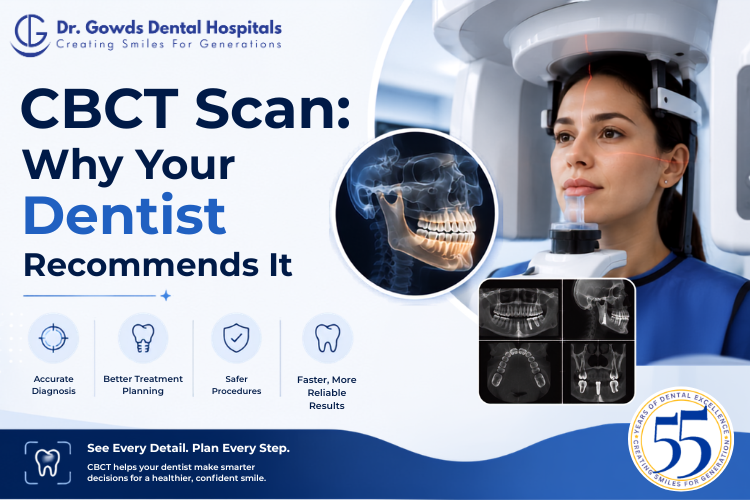
A CBCT Scan (Cone Beam Computed Tomography) is an advanced 3D dental imaging technology that provides detailed views of your teeth, jawbones, nerves, sinuses, and surrounding facial structures. Unlike traditional dental X-rays, which produce two-dimensional images, a CBCT scan creates a three-dimensional view that helps dentists diagnose complex dental conditions and plan treatments with greater precision. It is commonly used for dental implants, root canal treatment, wisdom tooth evaluation, orthodontics, jaw disorders, and oral surgery.
At Dr. Gowds Dental Hospitals, CBCT technology helps our specialists make accurate diagnoses and develop personalized treatment plans that improve both safety and long-term outcomes.
A CBCT Scan is a specialized type of dental imaging that uses a cone-shaped X-ray beam to capture hundreds of images around your head in a single rotation.
These images are combined by advanced software to create a highly detailed three-dimensional model of your:
This detailed view allows dentists to identify conditions that may not be visible on standard dental X-rays.
Traditional dental X-rays provide flat, two-dimensional images that are useful for routine examinations.
A CBCT Scan offers a much more comprehensive view.
| Regular Dental X-ray | CBCT Scan |
| Two-dimensional image | Three-dimensional image |
| Limited detail | Highly detailed anatomy |
| Basic diagnosis | Advanced diagnosis and treatment planning |
| Suitable for routine check-ups | Ideal for complex dental cases |
| Smaller field of view | Complete visualization of teeth and jaw structures |
The additional detail provided by CBCT imaging allows dentists to diagnose and treat conditions with greater confidence.
A CBCT Scan is recommended when detailed three-dimensional information is needed for accurate diagnosis or treatment planning.
Common reasons include:
Not every patient requires a CBCT scan. Your dentist will recommend it only when the benefits outweigh the need for additional imaging.
One of the most common uses of a CBCT Scan is dental implant planning.
Before placing an implant, the dentist needs to know:
Three-dimensional imaging allows precise implant placement, reducing surgical risks and improving long-term success.
A CBCT Scan helps endodontists identify problems that may not appear on regular X-rays.
It is particularly useful for:
The scan enables more accurate diagnosis and treatment planning.
Impacted wisdom teeth are often located close to important nerves.
A CBCT Scan allows dentists to determine:
This information improves the safety of wisdom tooth removal.
Orthodontists use CBCT Scan technology to evaluate:
This helps create customized orthodontic treatment plans for braces or clear aligners.
Patients with jaw pain or clicking may benefit from a CBCT Scan.
The scan provides detailed images of the temporomandibular joints, helping dentists diagnose:
A CBCT Scan offers several advantages over traditional imaging.
Three-dimensional images reduce guesswork and improve diagnostic accuracy.
Dentists can carefully plan procedures before treatment begins.
Detailed imaging allows more precise surgical techniques.
Important structures such as nerves and sinuses are clearly visible.
Most scans are completed in less than a minute.
The scan is painless and non-invasive.
Yes.
A CBCT Scan is considered safe when used appropriately.
Modern CBCT machines use lower radiation doses than conventional medical CT scans while providing highly detailed images of the oral and facial structures.
Dentists recommend CBCT imaging only when it provides important diagnostic information that cannot be obtained through routine dental X-rays.
No.
A CBCT Scan is completely painless.
There are:
Patients can resume normal activities immediately after the scan.
A CBCT Scan has transformed modern dentistry by providing highly detailed three-dimensional images that help dentists diagnose and treat complex dental conditions with greater precision. From dental implants and root canal treatment to wisdom tooth surgery and orthodontic planning, CBCT imaging improves accuracy, safety, and treatment outcomes.
Although not every patient needs a CBCT scan, it is an invaluable diagnostic tool when detailed information is required. The procedure is quick, painless, and designed to support better clinical decision-making.
If your dentist recommends a CBCT scan, it is because the additional information can help ensure safer, more effective, and more predictable treatment. At Dr. Gowds Dental Hospitals, our advanced imaging technology and experienced dental team work together to provide comprehensive care tailored to your individual needs.
Visit us at-
Dr gowds dental hospital Nanakramguda
Dr gowds dental hospital Gachibowli
Dr gowds dental hospital madhapur
A CBCT Scan is a three-dimensional dental imaging technique that provides detailed views of the teeth, jawbones, nerves, sinuses, and surrounding facial structures for accurate diagnosis and treatment planning.
Dentists recommend a CBCT scan for procedures such as dental implants, root canal treatment, wisdom tooth removal, orthodontics, TMJ evaluation, and complex oral surgery because it provides far more detail than regular dental X-rays.
Yes. A CBCT Scan is considered safe when used appropriately. It uses a lower radiation dose than a conventional medical CT scan and is recommended only when clinically necessary.
The scan itself usually takes 20 to 40 seconds, while the entire appointment is typically completed within a few minutes.
No. A CBCT Scan is completely painless, non-invasive, and does not require injections, anesthesia, or recovery time.

 Gachibowli Branch