

Schedule Appointment

Dental aligners have transformed orthodontic treatment for millions of people — no metal, no brackets, no food restrictions. But with so many options available in India, choosing the right one matters. This guide explains everything you need to know, from how aligners work to what they cost and what to expect at Dr. Gowds.
Medically Reviewed by: Prof. Dr. Snigdha Gowd, MDS (Orthodontics & Dentofacial Orthopaedics)
Book a free consultation at Dr. Gowds Dental Hospitals, Hyderabad. Clinical assessment, 3D scan and personalised cost estimate — no obligation.
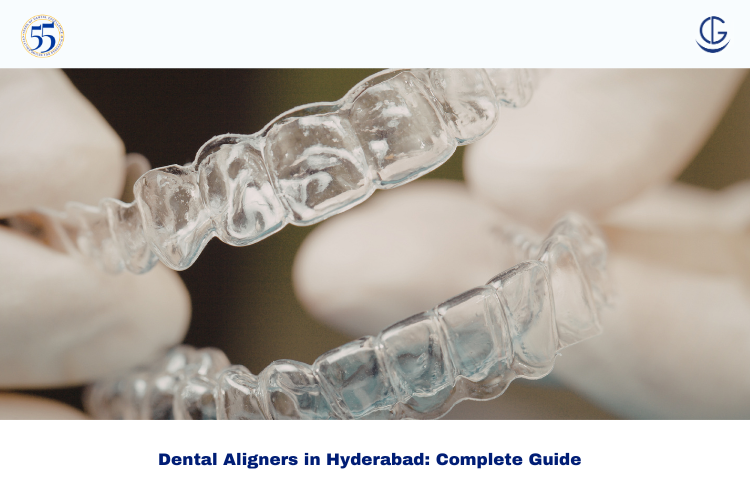
Dental aligners are custom-made, removable clear plastic trays that gradually shift your teeth into a straighter, better-aligned position. Each tray applies gentle and precisely controlled pressure to specific teeth. You wear each tray for one to two weeks before moving to the next, and over the course of your treatment — typically six to twenty-four months — your teeth progressively move toward their target positions.
Unlike fixed metal braces, aligners are virtually invisible in normal conversation and can be removed entirely for eating, drinking and oral hygiene. This combination of discretion, comfort and convenience has made them one of the most popular orthodontic options among adults and teenagers worldwide.
Not all aligners are the same. The right choice depends on your case complexity, budget, and how much clinical oversight you want throughout treatment. Here is a clear breakdown of every type available in the Indian market today.
Invisalign is the world’s most widely used and clinically studied clear aligner system, manufactured by Align Technology using patented SmartTrack thermoplastic material. Treatment is planned using ClinCheck software, which produces a 3D simulation of your entire tooth movement from start to finish — so you see your projected outcome before your first tray is made. As a certified Invisalign provider, Dr. Gowd’s can prescribe the right Invisalign product line for your specific case.
Beyond Invisalign, a range of in-clinic clear aligner systems are manufactured by domestic and international labs. These follow the same clinical workflow — digital scan, 3D treatment planning, custom tray fabrication — but use different materials and software. They tend to be more affordable while still being supervised by a trained dentist. At Dr. Gowd’s, all in-clinic aligner treatments are planned and monitored by certified orthodontists.
At-home aligner kits allow patients to take their own dental impressions at home and receive trays by post, without an in-person clinical assessment or ongoing dentist supervision. While the lower price is appealing, there are real clinical concerns: tooth movement without proper diagnosis risks root damage, bite problems, and gum issues. Our recommendation is always supervised, in-clinic treatment. If budget is the primary concern, our team can discuss affordable in-clinic options and flexible EMI plans.
Retainer aligners are clear trays worn after active treatment ends. Unlike treatment aligners, they hold teeth in their corrected positions — they do not move them further. Clear retainers look identical to treatment aligners but serve a completely different purpose. Most patients wear retainers every night indefinitely to permanently preserve their results.
Cases involving severe skeletal discrepancies — where the jaw bones themselves are significantly misaligned — may require surgical intervention. Very large gaps, extreme rotations, or cases requiring significant vertical movement may be better served by conventional fixed braces. Compliance is also a factor: aligners only work when worn for 20–22 hours daily. Patients unlikely to maintain this may achieve more predictable results with a fixed appliance.
| The only reliable way to find outA digital scan and clinical examination at Dr. Gowds will confirm in a single appointment whether aligners suit your case, which type is optimal, and how long treatment is likely to take. The consultation is free and carries no obligation to proceed. |
Every aligner treatment at Dr. Gowd’s Dental Hospitals follows a structured, technology-led workflow. Here is what to expect from your first appointment through to your finished smile.
Your first appointment includes a full clinical examination — bite, gum health, existing restorations. If aligners are appropriate, a 3D intraoral digital scan is taken in under five minutes, with no messy impression material. The scan produces a precise model of your dentition and is immediately uploaded to digital planning software.
Your scan is used to design your full treatment plan using digital software, producing a 3D animation of every stage of planned tooth movement — from your current position to your projected final smile. You review this at a follow-up appointment, suggest adjustments if needed, and approve the plan before any trays are manufactured.
Your aligner series arrives within a few weeks of approval. Your dentist fits your first trays, places any composite attachments needed, and provides a full wear protocol. You change trays every one to two weeks and attend a progress review every six to eight weeks. Most patients see visible results within the first two to three months.
A progress scan at the midpoint confirms tooth movement is tracking as planned. If any teeth have not moved fully as anticipated, refinement trays are prescribed. Refinements are a standard part of aligner treatment — not a sign of a problem. At Dr. Gowd’s, refinements are included in your treatment plan cost where clinically indicated.
Active treatment ends when your final aligner has been worn. Your dentist prescribes a retainer — a clear removable tray, a thin bonded wire behind the front teeth, or both — to hold your teeth in their new positions. The retention phase is non-negotiable. Most patients wear retainers every night for life to permanently preserve their results.
The number of trays is the single biggest cost driver — a direct function of how much tooth movement is needed. More complex cases, multiple arches, bite correction, and refinements all increase tray count and cost. Brand matters: Invisalign’s proprietary manufacturing commands a premium over generic in-clinic aligners. Provider certification also plays a role — Elite and Diamond-tier Invisalign providers typically charge more, reflecting advanced training and case volume.
Aligner care is straightforward but important. Neglecting tray hygiene leads to bacterial build-up, staining and bad breath. Here is the daily routine we recommend at Dr. Gowd’s.
What to do: rinse trays every time you remove them. Clean with a soft toothbrush and mild soap daily. Brush and floss before reinserting trays. Store in the provided case when not worn. Keep trays away from heat — they can warp. Drink plain water freely while wearing trays.
What to avoid: eating or drinking anything except water with trays in. Using toothpaste to clean trays — it scratches the surface. Leaving trays exposed on a table. Coloured mouthwash while trays are in — causes staining. Boiling water to clean trays — warps the plastic.
| Lost or broken a tray? Contact Dr. Gowds Dental Hospitals immediately. Do not go back to a previous tray without instruction — in some cases your dentist will ask you to move forward to the next tray instead. Never leave a gap in treatment: teeth begin moving back within days if no tray is worn. Visit us at- Dr gowds dental hospital Nanakramguda Dr gowds dental hospital Gachibowli Dr gowds dental hospital madhapur Dr gowds dental hospital koti |
A: Dental aligners are custom-made, removable clear plastic trays that gradually shift teeth into a straighter position. Each tray applies gentle pressure to specific teeth, and you change to the next tray every one to two weeks. Unlike fixed braces, they can be removed for eating, drinking and oral hygiene — making them one of the most convenient orthodontic options available today.
A: Mild misalignment can resolve in six to twelve months. Moderate cases typically take twelve to eighteen months. Complex bite correction cases may require up to twenty-four months. Your dentist at Dr. Gowd’s provides a personalized timeline after your 3D scan and digital treatment planning session — before you commit to any treatment.
A: For mild to moderate cases — crowding, spacing, overbite, underbite, open bite — aligners are clinically proven to be as effective as fixed braces. For severe skeletal discrepancies or extreme rotations, conventional braces may offer superior control. An in-person assessment at Dr. Gowd’s will clarify the best approach for your specific anatomy and lifestyle.
A: Yes. Modern aligner systems incorporate bite ramps and precision cuts for elastics specifically designed to correct overbites. Mild to moderate overbites are routinely treated with aligners at Dr. Gowd’s. Severe overbites with a skeletal component may need a combined approach — your dentist will assess the cause and severity at consultation.
A: Most patients experience mild pressure for two to three days after switching to a new tray — a normal sign that the aligner is working. There are no brackets or wires to irritate soft tissue. Over-the-counter pain relief is rarely needed beyond the first week. Discomfort significantly reduces as treatment progresses.
A: A minimum of twenty to twenty-two hours per day is required to keep treatment on schedule. Remove aligners only for eating, drinking anything other than water, and cleaning your teeth. Fewer hours delays treatment and may require additional trays — adding both time and cost. Compliance is the single biggest factor within a patient’s control that determines treatment success.
A: Invisalign is a specific brand of clear aligner — the most widely used and clinically studied globally, made by Align Technology using patented SmartTrack material and ClinCheck software. ‘Aligners’ is the broader category. All Invisalign products are aligners, but not all aligners are Invisalign. Other in-clinic aligner systems follow the same clinical process and achieve excellent results, often at a lower price.
 Gachibowli Branch