

Schedule Appointment


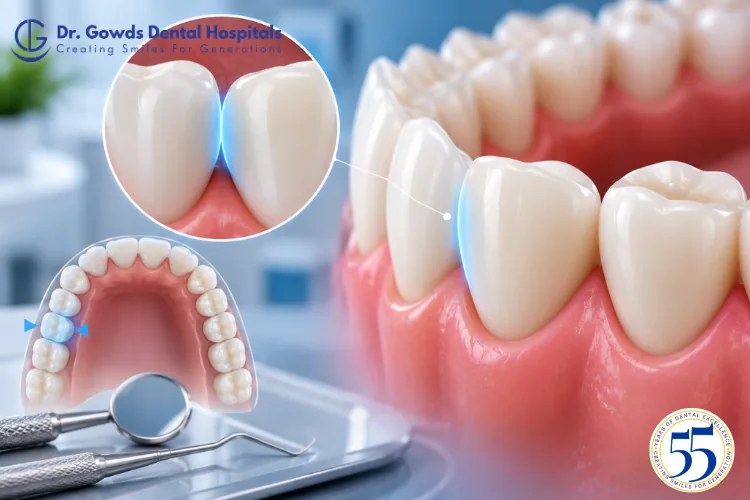
The mesial tooth surface is the part of a tooth that faces toward the midline of the dental arch.
The midline is an imaginary vertical line that divides the mouth into right and left sides. In general, a tooth’s mesial direction is toward the center of the dental arch.
The term “mesial” is commonly used by dentists when describing cavities, fillings, fractures, tooth movement, restorations, orthodontic changes, and other dental findings.
Understanding this term can make dental records and treatment discussions easier to follow.
The mesial surface also has an important relationship with the neighboring tooth because it often forms part of the contact area between adjacent teeth. This makes it relevant to tooth alignment, plaque control, gum health, and bite function.
“Mesial” is a directional term used in dentistry. It describes the position of a tooth surface or dental structure in relation to the midline.
It does not describe a disease or a specific type of tooth.
For example:
These anatomical terms allow dental professionals to describe the location of a finding precisely.
To understand the mesial surface, imagine a vertical line passing between the two upper central incisors and continuing through the center of the face.
A tooth surface that faces in the direction of this line is considered mesial.
For example, the surface of a canine that faces the neighboring incisor is its mesial surface. The opposite side, which faces toward the premolars, is its distal surface.
The same directional principle applies throughout the dental arch.
A simple way to remember it is:
Mesial = toward the middle
Distal = away from the middle
Mesial and distal describe opposite directions in dental anatomy.
The mesial surface is the side of a tooth that is closer to the midline of the dental arch.
The distal surface is the side of a tooth that is farther from the midline.
For most teeth, the mesial surface faces toward the front and center of the dental arch, while the distal surface faces farther toward the back.
Understanding the difference is useful when reading dental charts, treatment plans, and radiographic reports.
The mesial surface is closely related to the neighboring tooth and the surrounding gum tissue.
Much of this area forms part of the interproximal region, which refers to the area between adjacent teeth. These areas can be more difficult to clean thoroughly with a toothbrush alone.
Problems affecting the mesial surface or nearby contact area may be associated with:
Because parts of the mesial surface may be hidden between teeth, some dental problems can develop without being immediately visible.
Yes. Tooth decay can develop on the mesial surface, particularly around the contact area between neighboring teeth.
When decay occurs between adjacent teeth, it is often described as interproximal decay.
These areas can be difficult to inspect directly. Early decay may not produce a visible hole or noticeable symptoms, so a person may not realize there is a problem.
A dentist may use a clinical examination and, when appropriate, dental X-rays to evaluate areas that cannot be fully assessed visually.
There are several reasons why decay involving the mesial surface may remain unnoticed.
The contact area between two teeth is difficult to see clearly in a regular mirror.
A toothbrush may not adequately clean the tight space between adjacent teeth.
Tooth decay does not always cause pain in its early stages. A person can therefore have a developing cavity without realizing it.
Routine dental examinations can help identify problems before they become more extensive.
A mesial cavity may not cause symptoms initially. As decay progresses, possible symptoms can include:
These symptoms can also occur with other dental conditions, so they do not necessarily confirm a mesial cavity. A dental examination is needed to determine the cause.
Food repeatedly becoming trapped between two teeth can sometimes indicate a change in the contact between them.
Possible causes include:
Food trapping does not automatically mean that a cavity is present. However, if the same area repeatedly catches food, it is worth having the area examined by a dentist.
The gum tissue between adjacent teeth is also important for periodontal health.
Plaque accumulation around the mesial and interproximal areas can contribute to gum inflammation.
Possible signs of gum inflammation include:
Regular cleaning between the teeth can help remove plaque from areas that a toothbrush may not reach effectively.
If gum bleeding continues despite good oral hygiene, a dental evaluation can help identify the underlying cause.
The mesial surface should be included in a complete oral hygiene routine. Cleaning between adjacent teeth is particularly important because these areas can be difficult to reach.
Brush twice a day using fluoride toothpaste and a soft-bristled toothbrush.
Use dental floss or an appropriate interdental cleaning device to remove plaque and food debris between neighboring teeth.
Avoid snapping floss forcefully against the gums. Interdental cleaning should be controlled and gentle.
The spaces around premolars and molars can be particularly difficult to reach. Your dentist or dental hygienist can recommend an interdental cleaning method suited to your teeth.
If tooth decay affects the mesial surface, a dentist may recommend a filling depending on the size and depth of the lesion.
A filling restores the affected tooth structure and helps restore the tooth’s shape and function.
Dentists may use abbreviations to describe which tooth surfaces are involved.
For example:
Understanding these abbreviations can make dental charts and treatment discussions easier to understand.
Mesial and distal relationships are important when evaluating tooth position and alignment.
During orthodontic treatment, braces or clear aligners may gradually move teeth to improve alignment and the relationship between the upper and lower dental arches.
Orthodontic professionals evaluate how individual teeth relate to neighboring teeth and surrounding structures.
Good oral hygiene is especially important during orthodontic treatment because braces and other appliances can make plaque removal more challenging.
Yes. Like other tooth surfaces, the mesial surface can be affected by several problems, including:
Problems between two teeth can be difficult to recognize without professional examination.
If you notice a sharp edge, persistent sensitivity, recurring food trapping, or pain between teeth, a dentist can determine whether the mesial surface or another part of the tooth is affected.
Dental X-rays can help dentists assess areas between teeth that may be difficult to evaluate during a visual examination.
For example, interproximal decay may not always be visible during a routine examination, particularly during its early stages.
The type and frequency of dental imaging should depend on factors such as age, symptoms, dental history, examination findings, and individual risk.
X-rays can provide additional information about areas that cannot be fully assessed by looking at the teeth directly.
Children can also develop decay affecting the mesial surfaces of their teeth.
Because primary teeth can have relatively close contacts, cavities between neighboring teeth may not be obvious to parents.
Regular dental examinations and appropriate preventive care can help identify problems early.
Parents can also encourage children to develop good brushing and interdental cleaning habits according to recommendations from their dental professional.
A cavity does not necessarily remain the same size if it is left untreated.
If decay progresses, it can involve deeper layers of the tooth and may eventually require more extensive treatment.
Depending on the severity, management may range from preventive or minimally invasive care to restorative treatment. If decay becomes deep enough to affect the pulp, more complex treatment may be necessary.
Not every cavity progresses in exactly the same way, but detecting and managing tooth decay early can provide more opportunities for conservative treatment.
Consider scheduling a dental examination if you experience:
You do not always need to wait for symptoms. Routine dental examinations can help identify hidden problems involving the mesial and other tooth surfaces.
At Dr Gowds Dental Hospitals, identifying the exact location of a dental concern is an important part of diagnosis and treatment planning.
When a problem involves the mesial surface, the dentist may assess the affected tooth, neighboring tooth, contact area, gums, and surrounding structures.
Depending on the diagnosis, treatment may involve preventive care, restorative dentistry, periodontal care, orthodontic management, or another appropriate approach.
A detailed examination can help determine whether a concern involving the mesial surface is related to decay, food trapping, gum inflammation, tooth wear, a damaged restoration, or another dental condition.
Visit us at-
Dr gowds dental hospital Nanakramguda
Dr gowds dental hospital Gachibowli
Dr gowds dental hospital madhapur
The mesial tooth surface is the side of a tooth that faces toward the midline of the dental arch.
Although it is a simple anatomical term, the mesial surface has an important relationship with neighboring teeth and the surrounding gum tissue. Problems affecting this area can include tooth decay, plaque accumulation, food trapping, gum inflammation, tooth damage, and changes in tooth position.
Because much of the mesial surface is located next to another tooth, some problems can remain hidden for a period of time.
Brushing twice daily with fluoride toothpaste, cleaning between the teeth, maintaining good oral hygiene, and attending routine dental examinations can help protect these less-visible areas.
If you experience recurring food trapping, sensitivity, bleeding, or discomfort between two teeth, do not ignore it simply because you cannot see an obvious problem. A dental examination can help identify the cause and determine whether treatment is necessary.
The mesial tooth surface is the side of a tooth that faces toward the midline of the dental arch.
Mesial is a directional term meaning toward the midline of the dental arch. Dentists use it to describe the location of a tooth surface or dental finding.
The mesial surface faces toward the midline, while the distal surface faces away from the midline.
Yes. Tooth decay can develop on the mesial surface, particularly around the contact area between neighboring teeth where plaque can be difficult to remove.
Food trapping may occur because of tooth decay, changes in tooth position, gum recession, damaged restorations, missing teeth, or changes in the contact between teeth. A dentist can determine the cause.
Brushing cleans accessible tooth surfaces, but the contact area between neighboring teeth may require floss or another appropriate interdental cleaning method.
No. Early tooth decay can be painless. Pain or sensitivity may develop if the decay progresses.
MO means that a dental finding or restoration involves the mesial and occlusal surfaces of a tooth.
MOD stands for mesial, occlusal, and distal, indicating that all three tooth surfaces are involved.
Brush twice daily with fluoride toothpaste, clean between your teeth regularly, limit frequent exposure to sugary foods and drinks, and maintain routine dental examinations.

 Gachibowli Branch