

Schedule Appointment


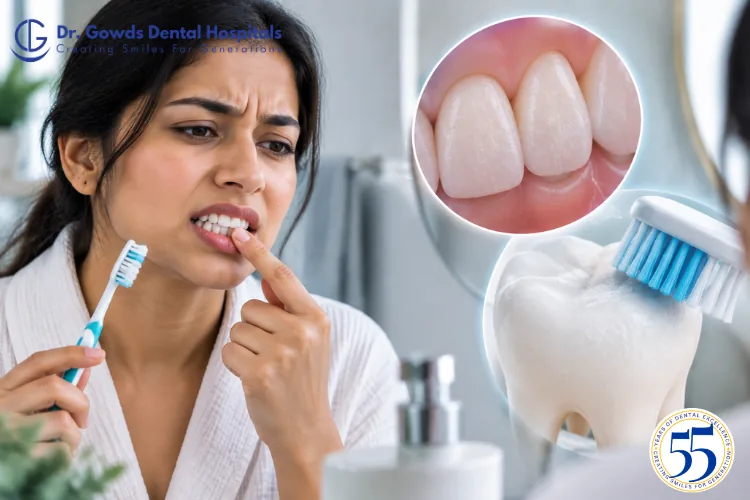
You brush your teeth carefully, rinse your mouth, and run your tongue over your teeth, only to notice that they still feel rough or grainy. If your teeth feel rough after brushing, it can be tempting to assume that your toothbrush is not cleaning properly.
However, a rough tooth surface can have several possible causes. The sensation may be related to plaque, hardened tartar, enamel wear, a small chip, a rough dental restoration, staining, or another change to the tooth surface.
At Dr Gowds Dental Hospitals, the cause of persistent roughness can be assessed by examining the teeth and gums. The location of the roughness, how long it has been present, and whether it occurs with sensitivity, discoloration, bleeding, or pain can provide useful clues.
Healthy tooth enamel generally feels relatively smooth when you run your tongue over it. However, teeth are not perfectly polished surfaces. Natural grooves, anatomical variations, and the junctions between different tooth surfaces can create slight differences in texture.
A new or noticeable change in texture is different. You may describe the sensation as:
The type and location of the roughness may help indicate what is causing it.
Plaque is a soft, sticky film that forms continuously on teeth. Even after brushing, some plaque may remain in areas that are difficult to clean, particularly:
Plaque can make teeth feel slightly fuzzy or coated.
Unlike tartar, plaque is generally soft enough to be disrupted and removed through effective brushing and interdental cleaning.
One of the most common reasons for persistent roughness is tartar, also called dental calculus.
When plaque remains on the teeth, it can become mineralized and harden. Once tartar has formed, ordinary brushing cannot reliably remove it.
Tartar may feel like:
The important distinction is that brushing helps control soft plaque, while hardened tartar generally requires professional dental cleaning.
Trying to scrape tartar off yourself can injure the gums or potentially damage the tooth surface.
Enamel is the hard outer layer of the tooth. Changes caused by wear or chemical erosion can affect how smooth a tooth feels.
Possible contributing factors include:
Once enamel has been permanently lost, the body cannot naturally replace it in the same way it forms new enamel during tooth development. Protecting the remaining tooth structure is therefore important.
Frequent or prolonged exposure to acids can contribute to enamel erosion. Common sources include:
Having an acidic food or drink occasionally does not necessarily cause noticeable enamel damage. The frequency and duration of acid exposure are important factors.
You may notice that certain teeth feel:
If you regularly experience tooth sensitivity along with a change in tooth texture, a dental examination can help determine whether enamel wear or another issue is involved.
Sometimes the roughness is not caused by a deposit at all.
A small chip in the enamel can create an edge that your tongue notices immediately. You may experience:
Small chips may not always be easy to see in a mirror.
If the roughness appeared suddenly and is limited to one tooth, a dentist can check whether the tooth has chipped or developed another structural problem.
A dental filling restores damaged tooth structure, but the restored area may feel slightly different from natural enamel.
You may notice a change in texture around:
If a filling feels rough, catches your tongue, or has developed a sharp edge, it should be checked by a dentist.
A restoration that feels unusually high when you bite should also be brought to your dentist’s attention.
The area where the teeth meet the gums can be particularly prone to plaque accumulation.
If plaque remains along the gum line, your teeth may feel rough even shortly after brushing. Persistent plaque buildup can also contribute to gum inflammation.
Look for accompanying symptoms such as:
If these symptoms occur together, improving daily oral hygiene and having a dental evaluation can help identify the underlying problem.
Certain foods, drinks, and tobacco products can contribute to external tooth staining.
When staining occurs alongside plaque or mineralized deposits, the surface of the tooth may feel different.
Common sources of external staining include:
Professional dental cleaning can remove many external deposits and stains. However, discoloration originating within the tooth may require a different approach.
The location of the roughness can provide useful clues about its possible cause.
This area commonly accumulates plaque and mineralized deposits. If the roughness remains after brushing, professional cleaning may be needed.
Plaque, tartar, trapped food debris, or a rough restoration may contribute to the sensation.
Plaque, tartar, enamel wear, or changes associated with the gums may be involved.
A small chip, tooth wear, or grinding may be worth investigating, particularly if the change appeared recently.
A filling, chip, crack, decay, localized deposit, or another surface change could be responsible.
Brushing is essential for oral hygiene, but it has limitations.
A toothbrush is designed to disrupt plaque and clean accessible tooth surfaces. It cannot remove every substance that may alter the texture of a tooth.
For example:
Soft plaque: Brushing and interdental cleaning can usually help remove it.
Hardened tartar: Professional dental instruments may be required.
Enamel loss: Brushing cannot rebuild enamel that has already been permanently lost.
A chipped tooth: Brushing cannot restore missing tooth structure.
This is why brushing harder is not necessarily the solution when your teeth feel rough.
No. Using excessive pressure can potentially make certain dental problems worse.
Aggressive brushing may contribute to:
A soft-bristled toothbrush and gentle brushing technique are generally preferable to scrubbing harder.
The goal is to remove plaque effectively while protecting the teeth and gums.
Some whitening toothpastes use mildly abrasive ingredients to help remove surface stains.
Using an abrasive product too aggressively or too frequently may contribute to tooth surface wear, particularly in people who already have enamel wear or sensitivity.
If your teeth have become increasingly sensitive or their surface texture seems to have changed, speak with a dentist about whether your toothpaste and brushing technique are appropriate.
Whitening toothpaste should not be used as a substitute for investigating a new or persistent rough area.
A cleaner-feeling mouth involves more than brushing alone.
Brush twice daily using fluoride toothpaste and a soft-bristled toothbrush.
Use floss or another suitable interdental cleaning method to remove plaque from areas a toothbrush cannot reach.
Use gentle brushing movements along the gum line instead of pressing the toothbrush aggressively against the gums.
Drinking water can help rinse away food particles and reduce frequent exposure to sugary or acidic beverages.
If hardened deposits are responsible for the roughness, professional cleaning may be necessary.
Regular dental examinations can also help identify problems that may not be obvious at home.
Consider making a dental appointment if the rough feeling:
A dentist can determine whether the roughness is caused by a removable deposit or an actual change to the tooth or restoration.
Treatment depends on the underlying cause.
Improved brushing and interdental cleaning may help remove plaque and prevent it from accumulating.
Professional scaling can remove hardened tartar deposits.
The restoration may be polished or adjusted. If it is damaged or otherwise unsuitable, replacement may be considered.
Treatment focuses on protecting the remaining tooth structure, reducing contributing factors, and managing any associated sensitivity or other symptoms.
Depending on the extent of the damage, a dentist may recommend smoothing, dental bonding, a restoration, or another appropriate treatment.
There is no single treatment for every rough tooth surface. Identifying the cause is the first step.
Sometimes.
Tooth decay can change the surface of a tooth, particularly as the enamel breaks down. You may notice:
However, roughness alone does not mean that you have a cavity.
A dental examination is needed to determine whether tooth decay is present and whether treatment is necessary.
If your teeth feel rough after brushing, do not automatically assume that you need a stronger toothbrush or a more aggressive brushing technique.
The sensation could be caused by soft plaque, hardened tartar, enamel wear, acid exposure, a small chip, a rough filling, or another dental change. The location of the roughness and whether it occurs with sensitivity, bleeding, discoloration, or pain can provide useful clues.
If your teeth suddenly feel different or a rough patch remains despite consistent oral care, a dental examination is worthwhile. Sometimes the solution is simply professional cleaning. In other cases, the roughness may indicate a tooth or gum problem that needs attention.
Smooth-feeling teeth are not about brushing harder. They are about understanding what is changing on the tooth surface and addressing the cause appropriately.
Visit us at-
Dr gowds dental hospital Nanakramguda
Dr gowds dental hospital Gachibowli
Dr gowds dental hospital madhapur
Persistent roughness can be caused by tartar, plaque that remains in difficult-to-clean areas, enamel wear, a chipped tooth, a rough filling, or another change in the tooth surface.
A gritty sensation may be related to plaque, mineralized deposits, or changes in the enamel surface. If the sensation remains after brushing, a dentist can determine the cause.
No. Brushing helps prevent plaque buildup, but hardened tartar generally requires professional dental cleaning.
They can, but roughness alone does not confirm tooth decay. Cavities may also cause sensitivity, food trapping, discoloration, or pain.
A single rough tooth may have a chipped area, filling, crack, decay, localized deposit, or another surface change. Persistent roughness affecting one tooth should be examined.
Yes. Enamel can undergo wear or erosion, which may change the texture of a tooth and sometimes increase sensitivity.
No. Brushing too aggressively can contribute to gum recession, tooth abrasion, and sensitivity. Gentle brushing with a soft-bristled toothbrush is preferable.
If plaque is responsible, effective brushing and interdental cleaning can help. If tartar, a rough restoration, enamel damage, or a chipped tooth is responsible, professional dental care may be necessary.
See a dentist if the roughness persists, appears suddenly, affects one tooth, feels sharp, or occurs with sensitivity, pain, bleeding gums, discoloration, or persistent bad breath.


 Gachibowli Branch