

Schedule Appointment


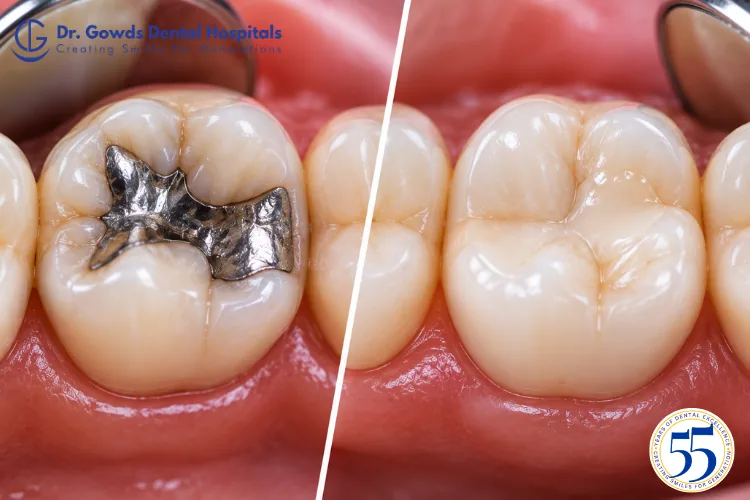
Choosing a dental filling involves more than deciding between a silver-colored restoration and a white one. The most appropriate option depends on factors such as the location of the cavity, the amount of healthy tooth structure remaining, the size and depth of the decay, biting forces, and your individual dental needs.
At Dr Gowds Dental Hospitals, dentists evaluate the affected tooth and surrounding oral structures before recommending a suitable restoration. Understanding the differences between metal fillings and tooth-colored fillings can help you have a more informed discussion about your treatment options.
Both types of fillings can restore teeth affected by decay or damage, but they differ in material, appearance, placement technique, bonding characteristics, and clinical considerations.
Metal fillings commonly refer to dental amalgam, a restorative material made from a mixture of metals that includes silver, tin, copper, and elemental mercury.
Amalgam has been used in dentistry for many decades, particularly for restoring cavities in back teeth where chewing forces can be considerable.
One of its most recognizable characteristics is its silver-gray appearance. Because it does not match the natural color of the tooth, an amalgam filling can be more noticeable when a person smiles, laughs, or speaks.
Tooth-colored fillings are commonly made from composite resin, a restorative material designed to closely match the appearance of natural teeth.
The dentist selects a shade that blends with the surrounding tooth structure. This allows composite restorations to provide a more discreet and natural-looking result than visible metal fillings.
Tooth-colored fillings can be used for cavities in both front and back teeth when the tooth and restoration are suitable for composite treatment.
| Feature | Metal Fillings | Tooth-Colored Fillings |
|---|---|---|
| Common material | Dental amalgam | Composite resin |
| Appearance | Silver or gray | Tooth-colored |
| Cosmetic appearance | More noticeable | Blends with natural teeth |
| Typical use | Historically common in posterior teeth | Used in front and back teeth depending on the case |
| Tooth preparation | Depends on the cavity and restoration | Often allows conservative preparation |
| Bonding to tooth | Does not bond adhesively like composite | Can bond to tooth structure using adhesive systems |
| Moisture control | Generally less moisture-sensitive during placement | Requires careful moisture control |
| Repairability | Depends on the condition of the restoration | Some smaller defects may be repairable |
| Durability | Can be durable in appropriate situations | Can be durable when properly placed and maintained |
This is a general comparison. The most appropriate material depends on the individual tooth and the patient’s clinical circumstances.
The most noticeable difference between metal fillings vs tooth-colored fillings is their appearance.
Metal amalgam fillings remain silver or gray after placement. This may be less important when restoring a molar at the back of the mouth, but some patients prefer to avoid a visible restoration.
Tooth-colored composite fillings are designed to blend with the surrounding enamel. This makes them particularly appealing for visible teeth and for patients who prefer a more natural-looking smile.
However, appearance is only one consideration. A filling also needs to provide appropriate function and support for the affected tooth.
The treatment process varies depending on the tooth, cavity, and selected restorative material.
For a composite filling, the dentist generally removes decayed tooth structure, prepares the area, applies an adhesive system, places the composite material in appropriate increments, and hardens it using a curing light.
The composite is then shaped to reproduce the tooth’s contours. The dentist checks the bite and makes any necessary adjustments before finishing and polishing the restoration.
Amalgam fillings use a different placement technique because amalgam does not bond adhesively to tooth structure in the same way as composite.
The dentist determines the appropriate preparation and restoration technique based on the condition of the tooth.
This is an important consideration when comparing metal fillings vs tooth-colored fillings.
Composite fillings can be bonded to remaining tooth structure, which may allow the dentist to preserve more healthy tooth tissue in suitable cases.
Traditional amalgam restorations rely more on the shape and mechanical features of the prepared cavity for retention. This can influence how the tooth is prepared.
However, it is not accurate to assume that one material always requires more tooth removal. The amount of tooth structure that needs to be removed depends on the size, depth, location, and condition of the cavity, as well as the chosen restoration.
The goal is generally to remove diseased or compromised tooth structure while preserving as much sound tooth structure as reasonably possible.
Many patients assume that white fillings are only suitable for front teeth. That is not necessarily the case.
Modern composite materials can be used to restore many cavities in premolars and molars. However, their suitability depends on several factors, including:
A small or moderate cavity may be suitable for composite, while a severely weakened tooth may require a different restorative approach.
Longevity is one of the most common concerns when choosing between amalgam vs composite fillings.
There is no single lifespan that applies to every filling. How long a restoration lasts depends on several factors, including:
Both amalgam and composite restorations can eventually develop problems such as wear, fracture, marginal breakdown, recurrent decay, or loss of the restoration.
Regular dental examinations can help identify problems early and determine whether a filling needs monitoring, repair, or replacement.
Composite fillings can become discolored over time, particularly with frequent exposure to strongly pigmented foods and beverages.
The natural tooth surrounding the restoration can also change color because of aging, staining, or other factors. As a result, an older composite filling may sometimes appear different from the surrounding tooth.
Metal amalgam fillings do not develop surface staining in the same way because their silver-gray appearance comes from the restorative material itself.
If a tooth-colored filling becomes noticeably discolored, your dentist can assess whether polishing, repair, replacement, or another cosmetic option is appropriate.
Dental amalgam has been used extensively for many years, but because it contains elemental mercury, its use and safety continue to be considered in modern dental care.
The decision to place, retain, or replace an amalgam restoration should take into account the condition of the filling, the tooth being treated, the patient’s individual circumstances, and the availability of suitable alternatives.
A sound amalgam filling does not automatically need to be removed simply because it is silver-colored.
Unnecessary removal can involve removing additional tooth structure and exposing the patient to the risks associated with replacing an otherwise functional restoration.
If an amalgam filling is damaged, has recurrent decay around it, has fractured, or otherwise requires replacement, the dentist can discuss appropriate alternatives based on the individual case.
Sometimes, an existing metal filling can be replaced with a tooth-colored composite filling or another suitable restoration.
A dentist may recommend replacing an existing filling if there is:
However, replacing a functioning filling solely because it is visible is not always necessary.
Before replacing an amalgam filling, the dentist should examine both the restoration and the tooth underneath it. The potential benefits of replacement should be weighed against the amount of healthy tooth structure that may need to be removed.
There is no universal answer to whether tooth-colored fillings are better than metal fillings.
Tooth-colored composite fillings offer important advantages, including a natural appearance and the ability to bond to tooth structure using adhesive techniques.
They can also allow conservative preparation in suitable cases. However, composite placement is technique-sensitive and requires appropriate moisture control.
Amalgam has a long history of clinical use and can perform well in appropriate situations. Its silver-gray appearance, material characteristics, and current clinical considerations may make it less attractive for some patients or situations.
The better question is not simply:
“Which filling is better?”
Instead, ask:
“Which restoration is most appropriate for this particular tooth?”
A composite filling may be considered when:
The dentist will evaluate these factors before deciding whether composite is appropriate.
A filling is not the ideal restoration for every damaged tooth.
If decay is extensive or a significant amount of tooth structure has been lost, the remaining tooth may need additional protection.
Depending on the condition of the tooth, treatment may involve a:
The appropriate treatment depends on how much healthy tooth structure remains and whether the tooth can be predictably restored.
This is one reason why treating dental decay early can help prevent a relatively small cavity from becoming a more complex dental problem.
A lost filling should not be ignored.
When a filling falls out, the exposed tooth may become sensitive to cold, heat, sweets, or pressure. Food can also become trapped in the area, potentially increasing the risk of further irritation or decay.
Until you can see a dentist:
The dentist will determine whether the filling can be replaced or whether the tooth requires a different restoration.
Whether you have a metal or tooth-colored filling, good oral care can help protect the restoration and the surrounding tooth.
Brush twice daily with fluoride toothpaste and pay attention to the area around restored teeth.
Use floss or another dentist-recommended interdental cleaning method to remove plaque and food debris between teeth.
Frequent consumption of sugary foods and drinks can increase the risk of new tooth decay around existing restorations and on other teeth.
Do not use your teeth to open packages, bite hard objects, or perform tasks that can place excessive force on the teeth and fillings.
If you regularly clench or grind your teeth, discuss it with your dentist. Excessive forces can contribute to wear or damage affecting both natural teeth and restorations.
Routine dental examinations allow your dentist to monitor existing fillings, identify early signs of failure, and check for new decay.
At Dr Gowds Dental Hospitals, filling treatment begins with evaluating the tooth rather than choosing a material based only on appearance.
The dentist considers factors such as the location and size of the cavity, the amount of remaining tooth structure, biting forces, oral health, aesthetic preferences, and the condition of any existing restoration.
For patients comparing metal fillings with tooth-colored fillings, a dental consultation can help determine which restoration is appropriate for the specific tooth and whether an existing filling should be repaired, monitored, or replaced.
The choice between metal fillings and tooth-colored fillings involves more than aesthetics.
Metal amalgam fillings have a long history of clinical use, while tooth-colored composite fillings offer a natural appearance and adhesive bonding to tooth structure. Both materials have advantages and limitations.
For some teeth, composite may provide an appropriate combination of appearance, function, and tooth preservation. In other situations, the size, location, chewing forces, or condition of the tooth may make another restorative approach more suitable.
If you are deciding between metal fillings vs tooth-colored fillings, the best choice should be based on the individual tooth rather than simply whether the restoration looks silver or white.
A dental examination can help determine which restoration provides an appropriate balance of function, appearance, tooth preservation, and long-term oral health.
Visit us at-
Dr gowds dental hospital Nanakramguda
Dr gowds dental hospital Gachibowli
Dr gowds dental hospital madhapur
Neither material is universally better. Tooth-colored composite fillings offer a natural appearance and can bond to tooth structure, while amalgam has a long history of clinical use and can be durable in appropriate situations. The best option depends on the individual tooth and clinical circumstances.
Yes. Composite fillings can be matched to the shade of the surrounding tooth, making them much less noticeable than silver-colored amalgam fillings.
Dental amalgam has historically been widely used, particularly for posterior teeth. Whether it is appropriate today depends on the condition of the tooth, the patient’s individual circumstances, available alternatives, and the dentist’s assessment.
An existing amalgam filling can sometimes be replaced with composite or another restoration. However, replacement should be based on the condition of the filling and tooth rather than appearance alone. Your dentist can determine whether replacement is appropriate.
Composite fillings are bonded to tooth structure and can often be placed with conservative preparation. However, the effect on the tooth depends on the size and depth of the cavity, the remaining tooth structure, and the overall condition of the tooth.
Yes. Composite fillings can be used on many molars when the cavity and clinical conditions are appropriate. The dentist will consider factors such as cavity size, biting forces, moisture control, and remaining tooth structure.
There is no fixed lifespan for every filling. Longevity depends on factors such as the material, size and location of the restoration, oral hygiene, bite forces, diet, tooth grinding, and the condition of the surrounding tooth.
Yes. Fillings can become loose or fall out because of wear, recurrent decay, fracture, trauma, or problems affecting the tooth. A lost filling should be examined by a dentist so the appropriate treatment can be determined.
Not necessarily. A sound amalgam filling does not automatically need replacement simply because it is metal. Your dentist can assess the filling and explain whether replacement would provide a meaningful clinical benefit.
Your dentist can evaluate the cavity, remaining tooth structure, location of the tooth, bite forces, oral health, aesthetic preferences, and condition of any existing restoration before recommending the most appropriate filling material or restorative treatment.


 Gachibowli Branch