

Schedule Appointment


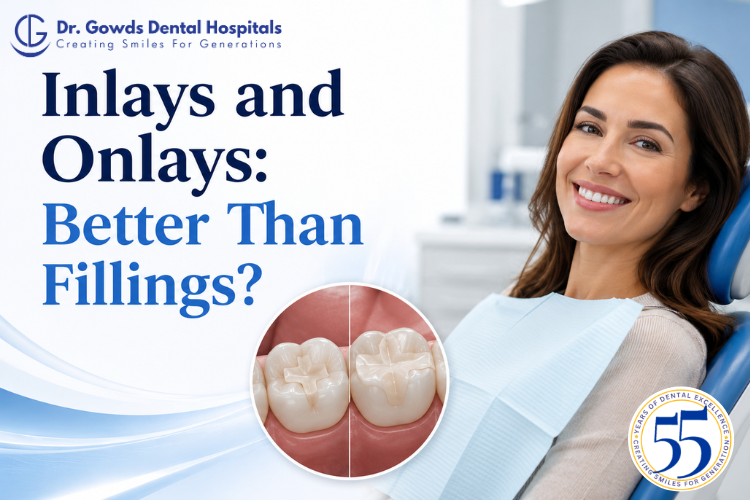
Inlays and Onlays are custom-made dental restorations used to repair teeth that have moderate decay or damage but do not require a full dental crown. They are designed outside the mouth using advanced digital technology or a dental laboratory and are then bonded securely to the tooth. Unlike traditional fillings, inlays and onlays provide greater strength and durability. Unlike crowns, they preserve more of the natural tooth structure, making them an excellent option for restoring damaged teeth while maintaining long-term oral health.
At Dr. Gowds Dental Hospitals, our restorative dentists use high-quality ceramic and composite materials to create precisely fitting inlays and onlays that restore both function and aesthetics.
Inlays and Onlays are indirect dental restorations that repair teeth with damage too extensive for a filling but not severe enough to require a crown.
They are custom-designed to fit the damaged portion of the tooth and are permanently bonded into place.
Because they are fabricated outside the mouth, they offer excellent accuracy, strength, and longevity.
Although often mentioned together, Inlays and Onlays restore different parts of a tooth.
A dental inlay fits within the grooves of the tooth without covering the cusps (the raised chewing surfaces).
It is used when damage is confined to the center portion of the tooth.
A dental onlay covers one or more cusps in addition to the chewing surface.
Because it restores a larger area, it provides extra protection for weakened teeth while preserving more natural tooth structure than a full crown.
Your dentist may recommend Inlays and Onlays if you have:
These restorations are especially useful when a traditional filling would not provide enough support, but a crown would require unnecessary removal of healthy tooth structure.
A filling works well for small cavities.
However, when too much of the tooth is damaged, a large filling may:
In these situations, Inlays and Onlays provide greater strength while preserving more healthy tooth tissue.
A dental crown covers the entire visible portion of a tooth.
Although crowns are excellent for severely damaged teeth, they require the removal of a significant amount of healthy enamel.
If the remaining tooth is still strong, Inlays and Onlays offer a more conservative treatment option by restoring only the damaged areas.
Modern Inlays and Onlays are available in several materials.
Ceramic restorations are highly popular because they:
Composite inlays and onlays provide natural aesthetics and are suitable for selected cases.
Although less commonly chosen today, gold restorations remain extremely durable and may still be recommended in specific clinical situations.
Understanding the treatment process helps patients know what to expect.
Your dentist examines the tooth using:
This helps determine whether an inlay, onlay, or crown is the most appropriate restoration.
The damaged or decayed portion of the tooth is carefully removed while preserving as much healthy tooth structure as possible.
A digital intraoral scanner or conventional impression records the exact shape of your prepared tooth.
The restoration is then custom-designed for a precise fit.
The inlay or onlay is fabricated using advanced CAD/CAM technology or by a dental laboratory.
High-quality ceramic or composite materials are used to ensure durability and aesthetics.
Your dentist checks the restoration for:
Minor adjustments are made if necessary.
The Inlays and Onlays are bonded securely using a strong dental adhesive.
The restoration is polished, and your bite is checked one final time.
There are several reasons dentists recommend Inlays and Onlays.
Only the damaged portion of the tooth is restored.
They reinforce weakened teeth and withstand normal chewing forces.
Tooth-colored materials blend beautifully with natural enamel.
Custom fabrication provides exceptional accuracy.
With proper care, inlays and onlays often last 10 to 15 years or longer.
They strengthen teeth that might otherwise crack under pressure.
| Feature | Inlays and Onlays | Fillings |
| Custom-made | Yes | No |
| Strength | Higher | Moderate |
| Durability | Excellent | Good |
| Tooth preservation | High | High |
| Suitable for larger damage | Yes | Limited |
| Lifespan | 10–15+ years | 5–10 years |
| Feature | Inlays and Onlays | Crowns |
| Covers entire tooth | No | Yes |
| Preserves healthy enamel | More | Less |
| Best for moderate damage | Yes | No |
| Best for severely weakened teeth | Sometimes | Yes |
| Conservative treatment | Yes | Less conservative |
Yes. One of the biggest advantages of Inlays and Onlays is their durability.
With proper care, they can last for many years.
Their lifespan depends on:
Good maintenance significantly increases their longevity.
Inlays and Onlays offer an ideal balance between traditional fillings and full dental crowns. They provide greater strength than fillings while preserving more natural tooth structure than crowns, making them an excellent choice for teeth with moderate damage.
Thanks to modern digital dentistry and high-quality ceramic materials, these restorations are highly durable, aesthetically pleasing, and designed to blend seamlessly with your natural smile. When recommended by your dentist, inlays and onlays can restore both function and confidence while helping protect your teeth for years to come.
If you have a damaged or weakened tooth and are looking for a conservative yet durable solution, consult the experienced restorative dentists at Dr. Gowds Dental Hospitals. We will evaluate your oral health and recommend the treatment best suited to your needs.
Visit us at-
Dr gowds dental hospital Nanakramguda
Dr gowds dental hospital Gachibowli
Dr gowds dental hospital madhapur
Inlays and Onlays are custom-made dental restorations used to repair moderately damaged or decayed teeth while preserving more natural tooth structure than a crown.
An inlay fits within the grooves of a tooth, while an onlay extends over one or more cusps to restore a larger portion of the chewing surface.
For moderate tooth damage, Inlays and Onlays are often stronger and more durable than large fillings because they are custom-made and bonded securely to the tooth.
With proper oral hygiene and regular dental check-ups, Inlays and Onlays can last 10 to 15 years or even longer.
The procedure is generally comfortable. Local anesthesia is used during tooth preparation, and most patients experience minimal discomfort during and after treatment.
 Gachibowli Branch