

Schedule Appointment


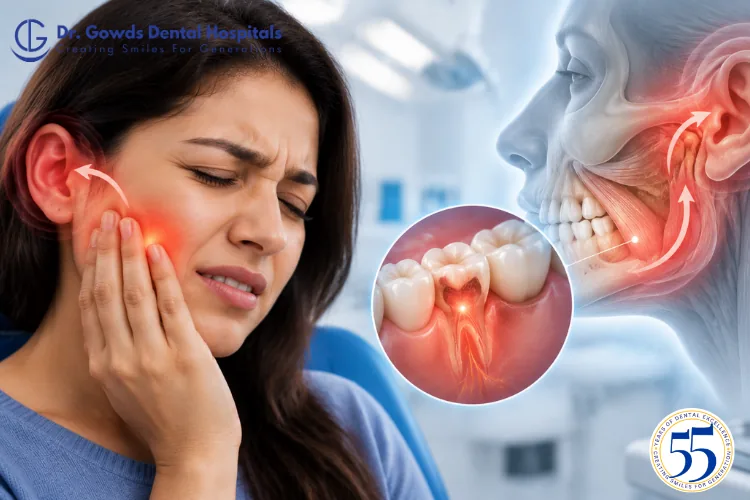
A toothache does not always remain limited to the affected tooth. Sometimes, pain can seem to travel toward the ear, jaw, cheek, temple, or nearby teeth, making it difficult to determine where the problem actually started.
This happens partly because several structures in the face and head share interconnected sensory nerve pathways. Pain originating from a tooth can therefore sometimes be perceived in another nearby area. This is known as referred pain.
For example, a problem involving a back tooth may feel like an earache or cause discomfort along the jaw. However, not every ear or jaw pain is caused by a tooth.
Understanding the pattern of symptoms can help distinguish common dental causes such as tooth decay, pulp inflammation, infection, cracks, or wisdom tooth problems from conditions affecting the jaw joint, muscles, or ear.
At Dr Gowds Dental Hospitals, identifying the source of pain is an important part of determining the appropriate treatment.
The teeth and many structures of the face receive sensory information through branches of the trigeminal nerve.
Because these nerve pathways serve multiple areas of the face and head, the brain may sometimes have difficulty identifying the precise origin of deeper pain signals.
This can cause referred pain.
A problem affecting one tooth may therefore be felt:
This does not necessarily mean that multiple structures are affected. In some cases, one problematic tooth is responsible for pain felt across a larger area.
A small cavity may initially cause little or no discomfort. As decay progresses deeper into the tooth, it can approach the pulp, which contains nerves and blood vessels.
At this stage, symptoms may include:
The deeper the decay, the more likely the tooth may require treatment beyond a simple filling.
The pulp can become inflamed because of deep decay, trauma, cracks, or other damage.
When the pulp is significantly inflamed, pain can become intense and difficult to localize.
You may experience:
Because this type of pain can be difficult to pinpoint, you may feel as though several teeth or a large area of the jaw are hurting.
A dental abscess is an infection that can cause a collection of pus around a tooth or within surrounding tissues.
Possible symptoms include:
The pain may extend toward the jaw, cheek, or ear.
A dental abscess requires professional assessment because the underlying source of infection needs appropriate treatment.
A cracked tooth can produce pain that is difficult to predict or localize.
Some people notice pain mainly when chewing, while others experience sensitivity to hot or cold foods and drinks.
Pain may:
Treatment depends on the location and severity of the crack and whether the tooth can be restored.
Wisdom teeth can cause pain toward the back of the mouth and jaw, particularly when they are partially erupted or impacted.
Food and bacteria can become trapped around a partially erupted wisdom tooth, potentially causing inflammation of the surrounding gum tissue.
Symptoms may include:
A dental examination can determine whether a wisdom tooth is contributing to the symptoms.
Not all dental-related jaw pain is caused by decay or infection.
Frequent teeth grinding or clenching can place excessive forces on the teeth and chewing muscles.
This may contribute to:
If grinding or clenching is suspected, a dentist can assess the teeth, bite, chewing muscles, and other signs of excessive pressure.
Yes, sometimes.
Pain from a tooth can be perceived around the ear because of overlapping sensory nerve pathways.
This possibility becomes more relevant when ear-area pain occurs together with dental symptoms such as:
However, not every earache is caused by a dental problem.
Ear infections and other conditions affecting the ear can cause similar symptoms. If dental examination does not identify a likely source, evaluation for other causes may be appropriate.
Yes.
An inflamed or infected tooth can cause pain that is perceived around the jaw, particularly when the affected tooth is toward the back of the mouth.
However, jaw pain can also originate from the temporomandibular joint (TMJ) or the muscles involved in chewing.
These patterns can overlap, so a proper examination is often necessary to identify the source.
One of the frustrating aspects of dental pain is that the tooth causing the problem is not always the tooth that feels most painful.
Pain from deeper dental tissues can be difficult for the brain to localize precisely. As a result, you may feel:
A dentist may therefore examine several teeth rather than focusing only on the location where you feel the strongest pain.
Diagnosis generally begins with a detailed history and dental examination.
Your dentist may ask:
The dentist may examine the teeth, gums, bite, jaw muscles, and surrounding tissues.
Depending on the findings, dental X-rays or other diagnostic tests may be recommended.
Not necessarily.
The appropriate treatment depends on the underlying cause.
A filling may be sufficient if the decay has not significantly affected the pulp.
Root canal treatment may be recommended when the tooth is restorable.
Treatment needs to address the source of the infection. Depending on the tooth and clinical findings, this may involve root canal treatment, drainage, extraction, or other appropriate care.
Treatment depends on the location and extent of the crack and whether the tooth can be restored.
Treatment may involve monitoring, managing inflammation, or removal, depending on the tooth’s position and clinical condition.
The goal is to identify and treat the cause rather than simply mask the pain.
If you are waiting for a dental appointment, some measures may provide temporary comfort:
These measures may provide temporary relief but do not repair a damaged tooth or eliminate a dental infection.
Do not delay professional treatment because the pain temporarily improves.
Arrange a dental evaluation if:
Early assessment can help identify dental problems before they become more complicated.
Seek prompt dental care if pain is accompanied by:
Seek urgent medical attention if facial or oral swelling is accompanied by:
These symptoms can indicate a potentially serious infection or other urgent condition.
Good preventive dental care can reduce the likelihood of tooth problems progressing to painful stages.
Helpful habits include:
Early treatment is generally preferable to waiting until a cavity, crack, or infection causes significant pain.
At Dr Gowds Dental Hospitals, patients experiencing tooth, jaw, or facial pain can receive a dental evaluation to help identify the likely source of their symptoms.
Depending on the findings, the dentist may assess for:
Because dental pain can sometimes be referred to nearby areas, identifying the source is an important part of selecting appropriate treatment.
Visit us at-
Dr gowds dental hospital Nanakramguda
Dr gowds dental hospital Gachibowli
Dr gowds dental hospital madhapur
Tooth pain spreading to the ear or jaw does not necessarily mean that the ear or jaw is the source of the problem. Dental decay, pulp inflammation, infection, cracked teeth, wisdom tooth problems, and excessive grinding can all contribute to pain that is perceived beyond the affected tooth.
At the same time, jaw-joint disorders, muscle problems, and genuine ear conditions can cause similar symptoms.
Because referred pain can make the source difficult to identify, persistent or recurring tooth, ear, or jaw pain should not be diagnosed based on location alone.
If your pain is accompanied by swelling, fever, drainage, difficulty opening your mouth, difficulty swallowing, or difficulty breathing, seek prompt professional care.
Early dental evaluation can help identify the underlying problem and determine the most appropriate treatment.
Yes. Pain from a tooth, especially a back tooth, can sometimes be perceived around the ear because of interconnected sensory pathways.
A dental problem such as deep decay, pulp inflammation, infection, or a cracked tooth can cause pain around the jaw. Jaw-joint or muscle problems can also produce similar symptoms.
Yes. A dental infection does not always cause obvious swelling. Persistent tooth or jaw pain should be evaluated even when swelling is not present.
Dental pain can sometimes be referred to the ear because the teeth and nearby facial structures share sensory nerve pathways.
A deep cavity that affects the inner part of the tooth can cause significant pain that may be felt around the jaw or nearby facial structures.
No. Jaw pain can be caused by dental decay, infection, wisdom tooth problems, cracks, grinding, or other dental conditions. TMJ and chewing-muscle problems are also possible causes.
Yes. Pain from some teeth can be perceived in nearby areas such as the jaw, cheek, ear, or temple because of interconnected sensory pathways.
You should arrange a dental evaluation when the pain is persistent, repeatedly returns, interferes with eating or sleeping, or occurs with swelling, fever, drainage, or significant tenderness.
Yes. A reduction or change in pain does not necessarily mean that an underlying dental problem has resolved. A tooth that previously caused significant pain may still require evaluation and treatment.
You cannot reliably determine the source based on location alone. A dental examination can help identify whether a tooth is responsible. If no dental cause is found, other possible causes may need to be evaluated.
 Gachibowli Branch